

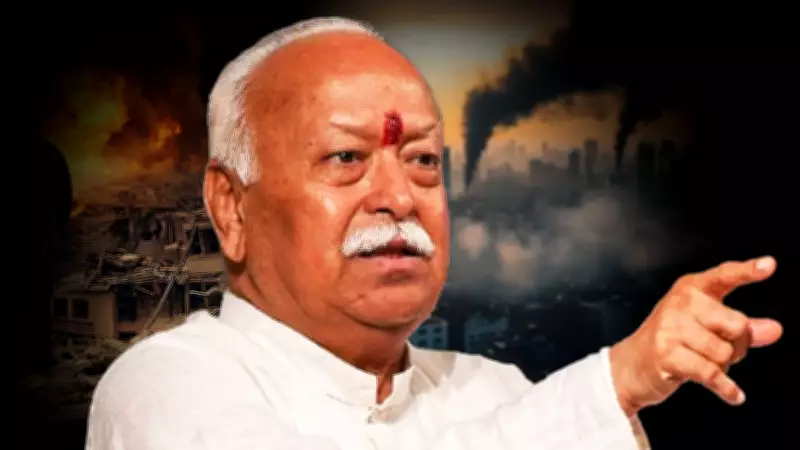
RSS Chief Mohan Bhagwat: India Guides World Through Crises Amid US-Iran Deadlock
In a powerful address delivered against a backdrop of escalating global uncertainty, Rashtriya Swayamsevak Sangh (RSS) chief Mohan Bhagwat has articulated a compelling vision for India's place on the world stage. His remarks, which come at a time of heightened tensions between the United States and Iran, position India not merely as a geopolitical entity but as a civilizational anchor offering guidance during international crises.
A Message of Steadfastness in Turbulent Times
Speaking on Saturday, April 13, 2026, Bhagwat emphasized that whenever nations find themselves engulfed in turmoil and conflict, India consistently emerges as a beacon of stability and wisdom. "India stands out as a guiding force," he declared, directly linking this role to the current volatile situation involving the US and Iran, which has sparked widespread concerns about the potential for renewed hostilities and regional instability.
The Foundation of India's Resilience
Delving into the core of his argument, Bhagwat highlighted India's profound cultural and spiritual heritage as the bedrock of its unique resilience. He asserted that this deep-seated foundation acts as a formidable shield against external shocks, particularly the pervasive forces of modern materialism and rampant consumerism that often destabilize other societies.

"This resilience allows India to remain stable and composed while other nations struggle with internal and external pressures," Bhagwat explained. He contrasted India's enduring value systems with the transient nature of material pursuits, suggesting that the country's philosophical depth provides a buffer against global economic and political fluctuations.
Redefining India's Global Identity
The RSS chief's statement contributes significantly to an ongoing, broader discourse about India's evolving identity in the 21st century. Bhagwat moved beyond conventional narratives that frame India solely as a strategic or economic player. Instead, he presented the nation as a civilization with timeless values—a perspective that reframes its global influence.
As the international community navigates a period marked by unpredictability in trade, diplomacy, and security, Bhagwat's remarks strategically position India as a steadying influence. This influence, he argues, is deeply rooted in ancient traditions, ethical belief systems, and a holistic worldview that prioritizes harmony over conflict.
Context and Implications
The timing of this address is particularly noteworthy. With headlines dominated by US-Iran standoffs and related geopolitical maneuvers, Bhagwat's message serves as a reminder of alternative paradigms for global engagement. It underscores a vision where India's role is not defined by military might or economic coercion but by its capacity to offer philosophical and moral direction.
This perspective invites reflection on how traditional knowledge systems can inform contemporary global governance and crisis management. Bhagwat's articulation reinforces the notion that in an interconnected world facing complex challenges, nations with deep civilizational continuity, like India, possess unique insights capable of guiding humanity toward more sustainable and peaceful coexistence.






