

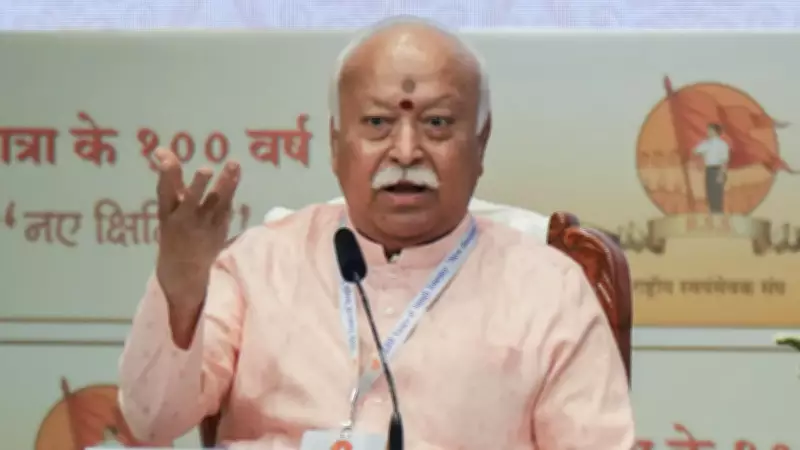
RSS Chief Mohan Bhagwat Outlines Organization's Core Philosophy at Mumbai Centenary Event
In a significant address during the Rashtriya Swayamsevak Sangh's centenary celebrations in Mumbai, RSS chief Mohan Bhagwat articulated the foundational principles of the organization, emphasizing that it was not established as a reaction or in opposition to any other entity. Bhagwat firmly stated that the Sangh does not pursue power or popularity, clarifying its purpose in the national context.
Clarifying the RSS's Origins and Objectives
"The Sangh has not emerged in competition with any other institution or organization, nor as a reaction or opposition to anyone," Bhagwat declared. "The Sangh does not seek popularity. The Sangh does not seek power. Whatever good deeds are being done in the country—may they be done well; the Sangh exists to help make that happen." He invited those curious about the RSS to engage directly with the organization, saying, "If you want to know Sangh, come inside and see it for yourself."
Highlighting Extensive Seva Activities Across India
Bhagwat provided insights into the extensive social work undertaken by RSS volunteers, noting that more than 130,000 small and large seva works are carried out nationwide. These initiatives are funded by the volunteers themselves, without government assistance, relying on societal cooperation. "In the history of our country, no Sangh-like work occurred after Tathagat Buddha," he remarked, underscoring the unique nature of these efforts. He added that the RSS's work is dedicated to the entire nation, Bharatvarsh.

Historical Context and Founder's Background
Reflecting on the period before the RSS's establishment in 1925, Bhagwat discussed the British creation of the Indian National Congress as a "safety valve," which Indians later transformed into a powerful tool for independence. He detailed the life of RSS founder Keshav Baliram Hedgewar, highlighting his challenging childhood, including the loss of both parents to plague at age 13 and subsequent financial struggles.
- Hedgewar actively participated in freedom movements, such as the Vande Mataram agitation during his school days.
- After excelling in his matriculation exam, community support enabled him to pursue medical education in Kolkata, where he connected with revolutionary groups.
- Bhagwat shared an anecdote where Hedgewar, using the code name "Koken" inspired by Kokenchandra, was mistakenly detained by police, as documented by Rash Behari Bose.
Event Details and Distinguished Attendees
The two-day lecture series, titled '100 Years of Sangh Journey: New Horizons,' aimed to reflect on the RSS's evolution, societal role, and future directions. The event saw the presence of notable figures, including film actor Salman Khan, filmmaker Subhash Ghai, and lyricist Prasoon Joshi, adding a cultural dimension to the proceedings.
Bhagwat's address served to demystify the RSS's intentions, focusing on its service-oriented mission and historical roots, while inviting broader understanding through direct engagement.






