

Mothers Brave Tiger Threats to Safeguard Children's School Commute in Maharashtra Village
"Mother, I won't go to school; I feel a tiger follows me." When Kiran Gedam's four-year-old son uttered these chilling words, a profound fear gripped her heart. Kiran resides in Sitaram Peth village, situated on the outskirts of the Tadoba Tiger Sanctuary in Maharashtra's Chandrapur district. This community is enveloped by dense forests on all sides, with the constant, looming threat of tiger attacks casting a shadow over daily life. The unpredictability of when or from where a tiger might emerge has made existence here fraught with danger.
A Village Living in Perpetual Fear
Since the tragic fatal attacks on two local brothers in 2017 and 2022, the villagers have endured a state of perpetual anxiety. Tigers are frequently spotted near the settlement, sometimes chasing motorbikes or wandering into the fields where crops are cultivated. While wildlife roams freely in the forest, the inhabitants of Sitaram Peth feel as though they are trapped in a cage, their movements constrained by fear.
The village falls within the Tadoba Tiger Reserve region, which is home to approximately 120 tigers. A critical challenge arises from a 400-meter mud road that connects the village to the bus stand. This path is flanked by dense forest on one side and agricultural fields on the other, with no streetlights to illuminate the way. Villagers often report tiger sightings along this stretch, yet it is the very route that 17 students must traverse daily to reach their school in Mudholi, located 7 kilometers away.

The Dangerous Daily Journey
To attend school, the children must catch a bus from the stand 400 meters from the village. However, this short distance becomes extremely hazardous due to the ever-present risk of wild animals. A tiger could appear at any moment, turning a routine commute into a life-threatening ordeal. Kiran recalls, "Every day the children would come home in fear. 'I saw a tiger Aai,' my son would tell me every other day. It was then that we decided that enough was enough."
With most villagers, including her husband, working at nearby resorts and unable to assist, Kiran took matters into her own hands. She joined forces with three other women from the village—Venu Randaye, Reena Nat, and Seema Madavi—to form a protective vigil. Their mission: to ensure the children could travel safely to and from school.
The Courageous Vigil of Four Mothers
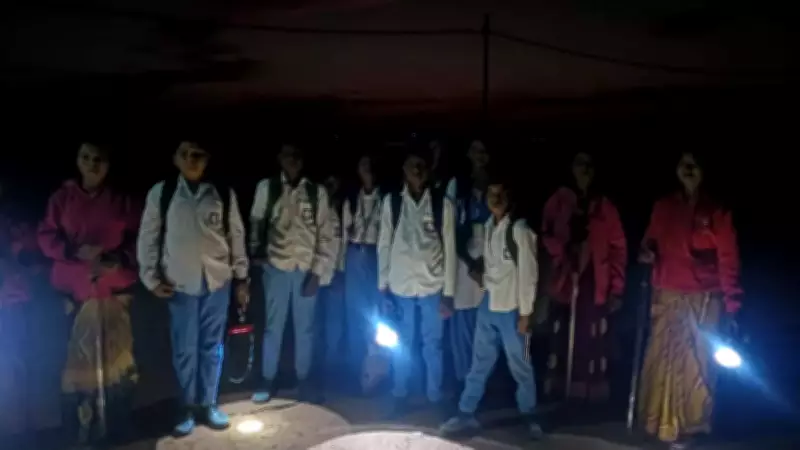
Armed with wooden sticks and torches, these four women brave the pitch darkness each day, standing guard on a road where a tiger attack could occur at any moment. At 9:30 a.m., they gather the children at the village square and escort them to the bus stand. The children walk in the middle, surrounded by the women on all sides, creating a human shield against potential threats.
Tigers are often seen near the bus stand as well, so the women remain vigilant until the bus arrives. Kiran proudly notes, "We have been given sticks and torches by the Forest Department, who also named us Matrisjakti." Despite this support, fear persists. "Lekin dar lagta hai, Tiger kabhi bhi aa sakta hai," she admits, with visible apprehension in her eyes.
Elaborate Safety Measures
Upon reaching the bus stand, all children stay inside while the four women position themselves facing each other. This formation allows them to spot a tiger approaching from any direction. When the children return by bus around 6:45 p.m., in complete darkness, the women form a protective circle again to escort them back to the village. During the walk, they scan the surroundings with torches, make noise with their sticks, and talk loudly to deter any nearby tigers.
Kiran shares, "When we go to pick up the children, we often see a tiger. Only yesterday I saw one. But we don't tell the children because they are already scared. Until we reach the village, we remain frightened. Once we reach the village, it feels like we have narrowly escaped."

Recognition and Ongoing Challenges
The forest department has acknowledged their efforts by providing uniform-coloured sarees, jackets, torches, and wooden sticks. Yet, fear continues to loom large in this tiger kingdom. Living at the jungle's periphery, the villagers have learned to coexist with one of nature's most formidable predators. What truly defines these women, however, is not just their courage in the face of constant danger, but the quiet strength of motherhood.
Their resolve demonstrates how maternal love can push fear aside, how responsibility can outweigh risk, and how dedication to one's children can become a powerful force. In the shadow of the jungle, these women stand not as victims of circumstance, but as steadfast protectors of their children's future, embodying resilience and hope in a challenging environment.





