Decoding the Muslim Vote Bank Narrative in Indian Politics
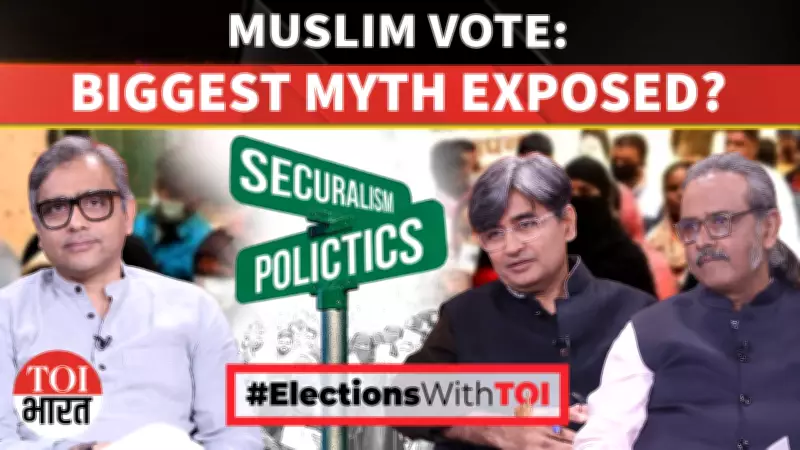
The concept of a unified Muslim vote bank has been one of the most persistent and debated narratives in Indian electoral politics. With approximately 20 crore Muslims spread across the country, the assumption that this diverse community votes as a single bloc requires thorough examination beyond surface-level political rhetoric.
State-by-State Variations in Muslim Voting Patterns
Renowned political analyst Hilal Ahmed emphasizes that Muslim voting behavior exhibits significant variations from state to state, challenging the notion of a monolithic vote bank. In states like Uttar Pradesh and Bihar, where Muslims constitute substantial portions of the population, voting patterns often reflect complex local dynamics rather than religious identity alone. Meanwhile, in southern states like Kerala and Tamil Nadu, Muslim political preferences frequently align with regional parties and specific socio-economic concerns.
Welfare Schemes Versus Identity Politics
A crucial question emerges: Are welfare schemes gradually overtaking identity politics as the primary determinant of Muslim voting behavior? Evidence suggests that economic considerations, access to education, healthcare provisions, and employment opportunities increasingly influence electoral choices within Muslim communities. This shift represents a significant evolution from traditional identity-based voting patterns that have dominated political discourse for decades.

The Polarization Paradox in Electoral Politics
The role of polarization in shaping or not shaping Muslim voting patterns presents a complex picture. While heightened communal tensions sometimes consolidate votes along religious lines, this phenomenon is neither universal nor consistent across different electoral contexts. In many instances, local issues, candidate credibility, and governance records prove more influential than broader polarization narratives promoted during election campaigns.
Emerging Political Movements and Representation
The Pasmanda movement, focusing on backward-class Muslims, highlights internal diversity within the community that mainstream political discourse often overlooks. This movement challenges the assumption of homogeneous Muslim political interests and raises important questions about representation beyond traditional leadership structures.
Furthermore, the perceived silence of so-called secular parties on specific Muslim issues has created representation gaps that various political actors attempt to fill. The elite-versus-masses divide in what critics term "politics of appeasement" reveals tensions between symbolic gestures and substantive policy interventions affecting Muslim communities.
BJP's Evolving Muslim Outreach Strategy
The Bharatiya Janata Party's approach to Muslim voters has undergone notable evolution in recent years. While the party's core support base remains predominantly Hindu, strategic outreach efforts targeting specific Muslim subgroups, particularly those emphasizing economic development over religious identity, represent a significant shift in political calculus. This approach contrasts with traditional assumptions about the party's relationship with Muslim voters.
Beyond Asaduddin Owaisi: Diverse Muslim Political Voices
The question of who truly speaks for Muslims in India extends far beyond prominent figures like Asaduddin Owaisi. Multiple voices, including local leaders, community organizations, women's groups, and youth activists, contribute to a complex political landscape where no single individual or party can claim to represent the entire community's diverse interests and aspirations.
This analysis reveals that the Muslim vote bank narrative oversimplifies a multifaceted reality. Electoral behavior among India's Muslim population reflects intersecting factors including regional variations, economic considerations, internal diversity, and evolving political strategies across the spectrum. As Indian democracy matures, understanding these complexities becomes essential for accurate political analysis and meaningful policy formulation.