

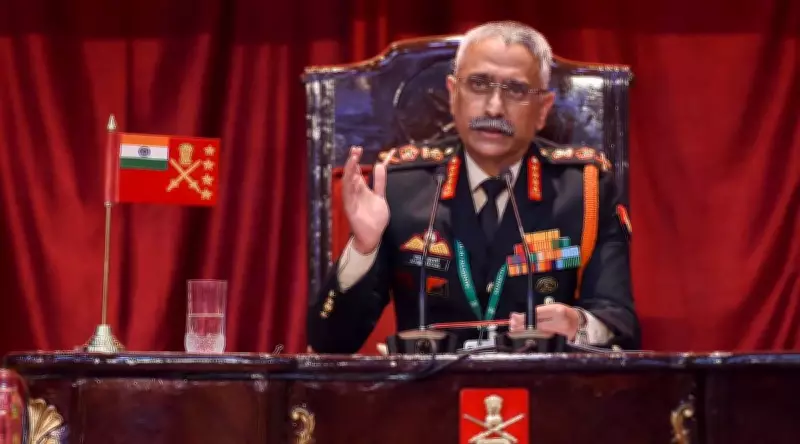
General Naravane's Unpublished Memoir Sparks Political Storm Amid Parliament Deadlock
With Parliament continuing to remain in a state of gridlock, the political focus has shifted dramatically to former Army chief General Manoj Mukund Naravane (Retd). The Lok Sabha's recent adoption of the Motion of Thanks to the President's Address without the Prime Minister's reply has highlighted the ongoing disruptions, primarily driven by Leader of Opposition Rahul Gandhi's insistence on quoting from General Naravane's unpublished memoir to target the government's handling of the 2020 standoff with China.
A Soldier at the Center of Political Confrontation
General Naravane served as Chief of the Army Staff from December 2019 to April 2022, a period marked by one of the most challenging military confrontations in recent Indian history. His tenure coincided with the prolonged standoff with China's People's Liberation Army along the Line of Actual Control, making his unpublished memoir particularly significant in current political discourse.
Navigating the China Crisis and Military Reforms
Barely months into his leadership, General Naravane faced the serious military confrontation with China that culminated in the June 2020 Galwan Valley clash, resulting in the tragic deaths of 20 Indian soldiers. This event marked a definitive turning point in India-China relations and required massive military mobilization in eastern Ladakh.

Under his strategic direction, the Army reinforced forward areas, upgraded critical infrastructure, and recalibrated operational posture along the entire LAC. Simultaneously, General Naravane oversaw groundbreaking military reforms including:
- The implementation of the transformative Agnipath recruitment scheme
- Comprehensive restructuring of Army Headquarters
- Strategic reorientation of Strike Corps formations
- Early foundational work toward creating Integrated Theatre Commands
Distinguished Military Career and Background
Commissioned into the 7th Battalion of the Sikh Light Infantry in June 1980, General Naravane's four-decade military career spanned diverse operational, instructional, and diplomatic assignments. His service included commanding a Rashtriya Rifles battalion in Jammu and Kashmir, serving with the Assam Rifles in the Northeast, and leading a Strike Corps on the western front.
His extensive counter-insurgency and counter-terrorism experience was complemented by diplomatic exposure as India's defence attache to Myanmar, providing him with valuable insights into regional geopolitics. Earlier in his career, he served with the Indian Peace Keeping Force in Sri Lanka, adding international peacekeeping experience to his credentials.
Path to Leadership and Educational Background
Before assuming the role of Army chief, General Naravane held several critical positions including Vice-Chief of the Army Staff, General Officer Commanding-in-Chief of the Eastern Command, and head of the Army Training Command in Shimla. These appointments placed him at the forefront of operational preparedness, force structuring, and doctrinal evolution during a period of rapid change in India's security environment.
Born in 1960 in Pune to an Indian Air Force officer father and noted Marathi writer mother, General Naravane's military journey began early. He joined the National Defence Academy at just 16 years old as part of the 56th course, alongside future service chiefs from other branches. After graduating from both the NDA and Indian Military Academy, he earned advanced degrees in defence studies and management.
Personal Life and Current Significance
Known for his soft-spoken demeanor and consensus-building approach within military circles, General Naravane has maintained a reputation for taking firm positions when strategic clarity was required. Outside his professional life, he is a keen non-fiction reader with particular affection for Nagaland, and is married to teacher Veena Naravane, with whom he has two daughters pursuing careers in performing arts and public relations.
The current political controversy surrounding his unpublished memoir underscores how military leadership decisions continue to resonate in national discourse, particularly regarding border security and defense policy matters that remain central to India's strategic interests.






