NDA Strengthens Upper House Position with Key Wins in Biennial Polls
The ruling National Democratic Alliance (NDA) significantly bolstered its presence in the Rajya Sabha during the latest round of biennial elections held on Monday. The alliance secured a decisive victory by winning eight of the eleven contested seats, including a clean sweep in Bihar and three crucial seats in Odisha, while the outcome in Haryana remained suspended due to a controversy over alleged violations of vote secrecy.
Election Context and Overall Results
Elections were conducted for only 11 of the 37 Rajya Sabha vacancies, with voting limited to Bihar, Odisha, and Haryana. The remaining 26 members had already been elected unopposed earlier in the process. Of these 11 contested seats, the NDA clinched eight victories, which included one Independent candidate backed by the alliance. The Biju Janata Dal (BJD) managed to secure one seat in Odisha, while counting for the two Haryana seats was abruptly halted late in the evening following complaints from both the Bharatiya Janata Party (BJP) and the Congress.
NDA's Dominant Performance in Bihar
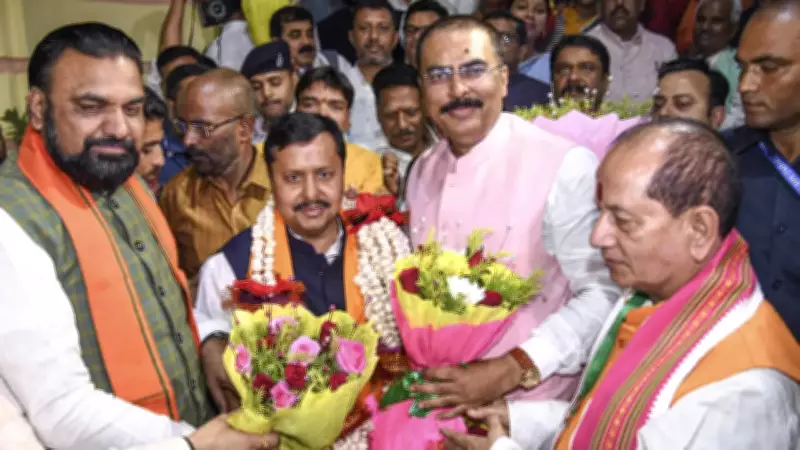
In Bihar, the NDA achieved a complete sweep by winning all five available Rajya Sabha seats. The successful candidates included JD(U) chief and Bihar's longest-serving Chief Minister Nitish Kumar, newly appointed Bihar BJP president Nitin Nabin, Union Minister Ram Nath Thakur, Rashtriya Lok Morcha chief Upendra Kushwaha, and BJP's Shivesh Kumar, who will be entering the Upper House for the first time.

Ram Nath Thakur and Upendra Kushwaha, both sitting members, were re-elected to their positions. Notably, outgoing MP Amarendra Dhari Singh faced defeat despite claims from RJD leader Tejashwi Yadav that he had secured support from five AIMIM MLAs and one BSP legislator.
BJP's Strategic Gains in Odisha Amid Allegations
The electoral battle in Odisha saw the BJP winning three of the four contested seats, including Independent candidate Dilip Ray, who received backing from the party. The other winners were BJP state unit chief Manmohan Samal, sitting MP Sujeet Kumar, and BJD's Santrupt Misra. The losing candidate was Dr. Datteswar Hota, the BJD-backed nominee who had support from the Congress and CPI(M).
The BJP's third victory in Odisha was marked by reports of cross-voting, with at least five MLAs—three from Congress and two from BJD—reportedly supporting Dilip Ray. This result quickly ignited a political confrontation, with BJD MLA Dibya Shankar Mishra accusing the BJP of engaging in "horse trading" and claiming that eight BJD MLAs had cross-voted.
Odisha Chief Minister Mohan Charan Majhi celebrated the outcome, describing it as an important milestone in the state's journey towards a "Samruddha Odisha" (Prosperous Odisha). He emphasized that this victory would strengthen Odisha's voice in the Upper House.
Haryana Counting Suspended Over Vote Secrecy Dispute
The most suspenseful development of the day occurred in Haryana, where counting for two Rajya Sabha seats was suspended after the BJP raised concerns about a "violation of vote secrecy" involving two Congress MLAs. The BJP's candidates are Sanjay Bhatia and Independent Satish Nandal, while the Congress has fielded Karamvir Singh Boudh.
Haryana minister Krishan Kumar Bedi alleged that the two Congress MLAs did not fold their ballots properly, thereby breaching secrecy norms. In response, the Congress launched a sharp counterattack. Party president Mallikarjun Kharge wrote to the Election Commission, alleging a "clear attempt to interfere with the integrity of the election" and warning that no legitimate vote should be disqualified.
Congress leaders also met with the Election Commission, demanding a review of CCTV footage and full video recordings of the polling process before any decision was made. Congress MP Syed Naseer Hussain suggested that the complaint appeared to be an afterthought, noting that no objections had been raised when the MLAs initially cast their votes.

Complex Electoral Arithmetic in Haryana
The Haryana contest had already garnered significant attention after the Congress relocated its MLAs to Himachal Pradesh ahead of polling, with them returning on Monday morning to vote. The INLD, which holds two MLAs, chose to abstain, further intensifying the electoral dynamics in the 90-member House, where 31 votes are required to secure a seat.
The current Assembly strength stands at 48 for the BJP, 37 for the Congress, two for the INLD, and three Independents, making the race particularly tight and competitive.
Earlier Unopposed Elections and Broader Implications
Monday's polling followed the earlier unopposed election of 26 candidates on March 9, which included prominent figures such as NCP (SP) chief Sharad Pawar, Union Minister Ramdas Athawale, former Lok Sabha deputy speaker M. Thambidurai, and Congress leader Abhishek Singhvi.
In Maharashtra, all seven candidates were elected unopposed; in West Bengal, the TMC's four nominees and BJP's Rahul Sinha were elected without a contest; in Telangana, Abhishek Singhvi and Vem Narender Reddy won unopposed; and in Tamil Nadu, all six candidates were elected uncontested.
Overall, this election round has clearly strengthened the NDA's position in the Upper House. With the alliance sweeping Bihar, expanding its influence in Odisha, and awaiting the final outcome in Haryana, the BJP is poised to emerge with the maximum number of seats in the Rajya Sabha after this election cycle, consolidating its legislative power and strategic advantage in national politics.