

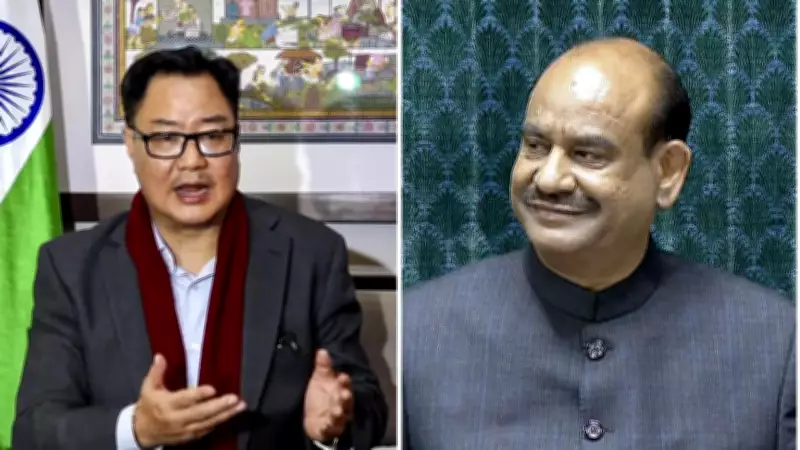
Lok Sabha to Debate No-Confidence Motion Against Speaker Om Birla on March 9
Union Parliamentary Affairs Minister Kiren Rijiju declared on Sunday that the Lok Sabha will conduct a debate and subsequent voting on a no-confidence motion against Speaker Om Birla on March 9. This announcement follows the submission of the motion by Congress MPs, which has garnered signatures from 118 members of Parliament.
Details of the Motion and Allegations
Rijiju, in a statement to news agency PTI, emphasized that parliamentary rules mandate the motion to be taken up on the first available day, with a vote to follow the debate. "On March 9 in the Lok Sabha, we will have the debate on the no-confidence motion moved against the speaker," he stated. "It is the rule to take it up on the first day. There will be a vote following the debate." Additionally, sources cited by ANI reported that a speedy review will be conducted as per established procedures.
The Opposition MPs have leveled serious accusations against Speaker Om Birla, claiming "blatantly partisan" conduct and alleging that leaders of opposition parties were systematically prevented from speaking in the House. This motion represents a significant challenge to the Speaker's impartiality and the functioning of parliamentary democracy.

Historical Context of No-Confidence Motions Against Speakers
This is not an isolated incident in Indian parliamentary history. Earlier in 2024, the opposition moved a similar no-confidence motion against then Rajya Sabha Chairman and Vice-President Jagdeep Dhankhar. Historically, there have been at least three notable instances since Independence when such motions were initiated to remove a Speaker:
- 1954: The first motion was against Lok Sabha Speaker GV Mavalankar, filed by MP Vigneshwar Misra, who alleged a lack of impartiality.
- 1966: Opposition MPs, led by Madhu Limaye, moved a motion against Speaker Sardar Hukum Singh, with Deputy Speaker S V Krishnamoorthy Rao presiding.
- 1987: On April 15, CPM MP Somnath Chatterjee introduced a motion for the removal of Speaker Balram Jakhar, which was ultimately axed by the House under Deputy Speaker Thambi Durai.
Nehru's Historic Stance on the 1954 Motion
The 1954 motion against Speaker GV Mavalankar sparked a fiery debate, with the Opposition, though numerically weak, accusing the Speaker of bias and targeting Prime Minister Jawaharlal Nehru. In a landmark intervention, Nehru addressed the Lok Sabha, urging members to prioritize the dignity of the House over party lines.
"I would like to address the House, if I may, in my capacity and the high privilege of being the Leader of this House and not as a leader of the majority party," Nehru stated. "So far as this majority party is concerned, I would like to tell them that not one of them is bound by any whip or any direction: let them vote as they like. It is not a party matter. It is a matter for this House, for each individual, to consider, regardless of party affiliations."
He further emphasized, "Therefore, let us try to think of it not as a party issue but as members of this House, because this matter affects the hon. speaker, of course, but it affects the high dignity of this House as Parliament." Nehru defended the Speaker's bona fides while acknowledging the constitutional right to move such a motion, highlighting the distinction between legal entitlement and propriety.
With the Congress holding a brute majority of over 360 seats at the time, the 1954 resolution was negated by a voice vote, underscoring the political dynamics at play.
Implications and Upcoming Proceedings
The upcoming debate on March 9 is poised to be a critical moment in India's parliamentary calendar, testing the Speaker's authority and the Opposition's resolve. As the Lok Sabha prepares for this significant event, it echoes historical precedents where such motions have shaped parliamentary discourse and accountability.
The outcome will not only impact Speaker Om Birla's tenure but also set a precedent for future interactions between the ruling party and the opposition in India's democratic framework.






