North Karnataka's Mixed Reactions to Union Budget 2026-27
The Union Budget for the fiscal year 2026–27, presented on Sunday by Union Finance Minister Nirmala Sitharaman, has generated a spectrum of responses across North Karnataka. Industry associations, political figures, economic experts, and student groups have provided diverse evaluations regarding its potential impact on the region and the nation at large.
Industry Welcomes Economic Balance but Seeks Regional Focus
The Karnataka Chamber of Commerce and Industry (KCCI), based in Hubballi, acknowledged that the Budget demonstrates a concerted effort to maintain comprehensive economic equilibrium, which they view as a positive development. According to the chamber, this duty-oriented fiscal plan is designed to stimulate national economic expansion and reinforce infrastructure development.
However, KCCI voiced significant disappointment over the absence of substantial commitments for industrial, infrastructure, and irrigation projects specifically targeting North Karnataka. The chamber highlighted several critical omissions:

- No specific proposals for establishing large-scale industries in the region.
- Lack of accelerated implementation for the Kalasa–Banduri Nala irrigation project.
- No prioritization of the long-awaited Hubballi–Belagavi railway line via Kittur.
- Insufficient commitments for road development and flyover projects.
Furthermore, KCCI noted that the non-allocation of funds for key railway projects—including Hubballi–Ankola, Gadag–Yalavigi, and Davanagere–Tumakuru—coupled with the absence of concrete agricultural and irrigation initiatives, has led to dissatisfaction among farmers and the general public in North Karnataka. "We are awaiting clarity in the detailed provisions of the Budget concerning ongoing projects," stated KCCI president GK Adappagoudar.
Political and Economic Perspectives
Hubballi–Dharwad West MLA and deputy leader of the opposition in the assembly, Arvind Bellad, welcomed the Budget, asserting that it aligns with the vision for a 'Developed India'. He praised the Centre's proposal to develop trekking routes along Karnataka's coastline and the announcement of new high-speed rail corridors connecting Bengaluru with Hyderabad and Chennai.
The Budget's emphasis on micro, small, and medium enterprises (MSMEs) was also highlighted as a constructive step. This includes credit guarantee support, promotion of the 'One Product One State' scheme, and a Rs 2,000 crore allocation under the Atmanirbhar Bharat initiative.
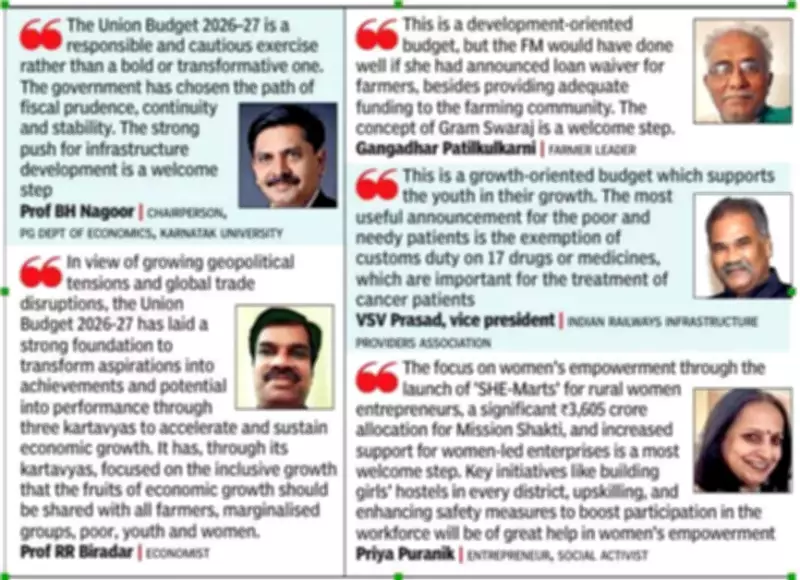
Economist Professor Rudragouda Biradar pointed out that initiatives such as financial sector reforms, skill development for Viksit Bharat, creation of a care ecosystem, promotion of sports heritage and tourism culture, and hubs for medical value tourism would contribute to sustained and inclusive growth.
In contrast, economist Professor BH Nagoor expressed concern that the Budget has not adequately focused on agriculture, rural development, skill creation, and employment generation. He noted, however, that the avoidance of populist schemes is noteworthy, as such measures could potentially strain the economy and exacerbate inflation.
Institutional and Professional Insights
The Institute of Chartered Accountants of India (ICAI) observed that the Budget emphasizes industry and technology-led growth through initiatives like the India Semiconductor Mission 2.0 and the BioPharma Shakti programme.
Chartered accountant YM Khatavkar noted that no changes were proposed in income tax rates, and expectations for an increase in the standard deduction were unmet, possibly due to substantial tax relief granted in the previous year. Nevertheless, he welcomed the removal of provisions imposing heavy penalties and criminal prosecution for minor errors under the Income Tax Act.

Student Organization's Criticism
Meanwhile, the All India Democratic Students' Organisation (AIDSO) criticized the Budget, alleging that it promotes the gradual privatization and corporatization of public education. AIDSO argued that under the guise of 'modernization', the government is withdrawing from its responsibility towards education and opening the sector to corporate interests. The organization also raised concerns over the emphasis on digital infrastructure, contending that it overlooks rural realities while primarily benefiting private ed-tech companies.
The varied reactions underscore the complex and multifaceted nature of the Union Budget 2026–27, with stakeholders in North Karnataka weighing its broader economic objectives against specific regional needs and priorities.