

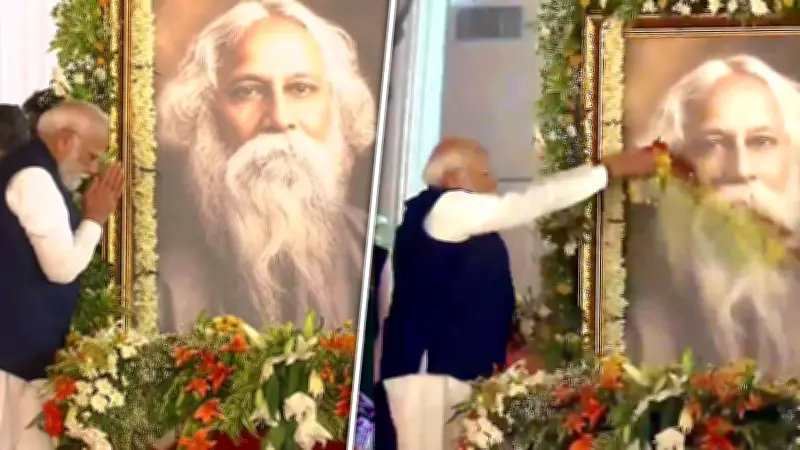
Prime Minister Narendra Modi paid tribute to Rabindranath Tagore on the occasion of Pochishe Boishakh, calling the Nobel laureate the “eternal voice of Indian civilisation.” The tribute came as West Bengal celebrated Rabindra Jayanti with cultural events and ceremonies across the state.
Modi’s Tribute to Tagore
In a series of posts on social media, PM Modi highlighted Tagore’s enduring influence on Indian culture and thought. He described Tagore as a poet, philosopher, and visionary whose works continue to inspire generations. “Rabindranath Tagore is the eternal voice of Indian civilisation. His thoughts on humanity, education, and nationalism remain relevant today,” Modi wrote.
Celebrations in West Bengal
West Bengal observed Rabindra Jayanti with great fervor. Cultural programmes, including dance, music, and theatre performances based on Tagore’s works, were held in Kolkata and other districts. Chief Minister-elect Suvendu Adhikari also honoured Tagore, attending a special event at the Rabindra Sarobar. “Tagore’s legacy is our heritage. We must preserve and promote it,” Adhikari said.

Political Context
The celebrations coincided with a historic political transition in the state. The BJP secured a landmark victory in the 2026 Assembly elections, ending decades of Trinamool Congress rule. Adhikari, who led the BJP’s campaign, is set to take oath as Chief Minister. The event marked a new chapter in West Bengal’s politics, with Tagore’s inclusive vision often cited by leaders across party lines.
Tagore’s Enduring Legacy
Rabindranath Tagore, born on May 7, 1861 (Pochishe Boishakh in the Bengali calendar), was the first non-European to win the Nobel Prize in Literature in 1913. He composed the national anthems of India and Bangladesh, and his works span poetry, songs, novels, and essays. Tagore’s emphasis on universal humanism and cultural synthesis continues to resonate in India and beyond.
The day’s events underscored Tagore’s role as a unifying figure in Indian civilisation, bridging regional and political divides. As West Bengal undergoes political change, Tagore’s ideals of harmony and creativity remain a guiding light.






