

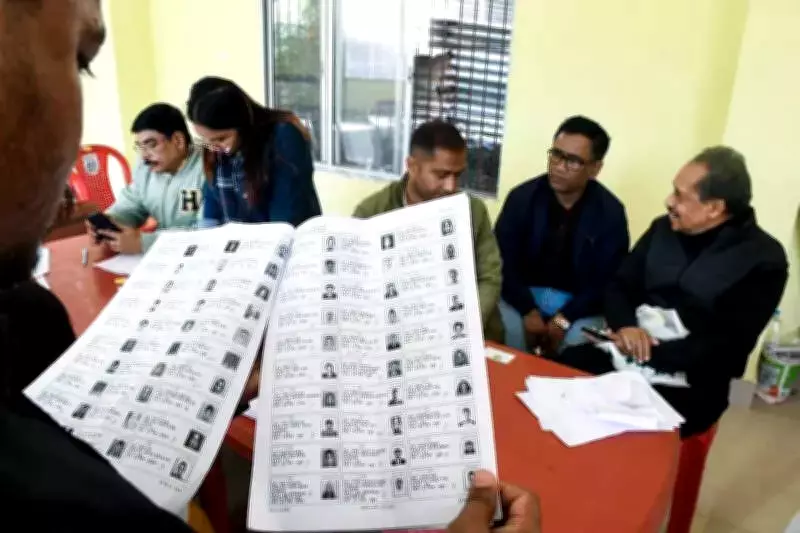
Punjab's Voter Roll Mapping Surpasses 55% Milestone in Special Revision Drive
Under the initial phase of the Special Intensive Revision (SIR) of electoral rolls, Punjab has achieved a significant milestone with voter list mapping crossing the 55% threshold. Chief Election Officer (CEO) Anindita Mitra announced that names of nearly 1.18 crore voters out of the state's total electorate of 2.14 crore have been successfully matched with the 2003 SIR voter list.
Sharp Disparities Emerge in District-Wise Progress
However, official data reveals concerning disparities in mapping progress across different districts, prompting the Election Commission to issue specific instructions to accelerate the process in lagging areas. Sahibzada Ajit Singh Nagar (Mohali) recorded the lowest mapping percentage in the state at just 39.77%, followed by Ludhiana at 48.36% and Patiala at 48.41%.
Within Patiala district itself, mapping progress varied significantly with rural areas at 37% and the city area at just 25%. Election officials have directed staff to prioritize mapping in these underperforming regions. A Patiala election officer attributed the slower pace to multiple factors including a high number of migrants, rapid urban expansion, and new settlements that complicate historical matching processes.

Top Performing Districts and Verification Challenges
On the positive side, several districts demonstrated strong progress in voter mapping. Moga district led the state with 65.73% mapping, closely followed by Mansa at 65.52%, Rupnagar at 64.03%, Barnala at 63.51%, and Shahid Bhagat Singh Nagar at 63.31%. Other districts showing commendable progress included Pathankot at 62.58%, Amritsar at 61.46%, and Sri Muktsar Sahib at 61.25%.
Booth Level Officers (BLOs) reported that record verification for married women emerged as one of the most time-consuming aspects of the exercise. In numerous cases, voter lists mentioned a woman's husband's name instead of her parents' names, creating complications when matching with the 2003 rolls. Surname changes or variations in names after marriage required meticulous cross-verification, significantly increasing the workload.
National Attention and Verification Procedures
The verification process gained national attention after the Chief Minister of West Bengal raised concerns in the Supreme Court, highlighting that married women risked being excluded from voter lists due to surname changes. The state government has opposed undue haste in completing such exercises, advocating for adequate time to ensure proper verification.
Election officials clarified that voters whose names or whose parents' names matched the 2003 voter list would not be required to submit any additional documents. For voters who turned 18 after 2003, verification proceeded through their parents' names in the older voter list, adding another layer of complexity to the process.
Monitoring and Future Expectations
CEO Anindita Mitra emphasized that voter mapping across Punjab continues to increase steadily, with districts showing slower progress being closely monitored. "Reasons for slow mapping are being identified, and all necessary arrangements are being put in place. A significant improvement is expected over the next few days," she stated.
The Election Commission reiterated that accuracy of electoral rolls remains the top priority, even as efforts intensify to complete the SIR process efficiently. Booth Level Officers have been instructed to temporarily step away from other assignments and focus exclusively on voter mapping to address the disparities and ensure comprehensive coverage across all districts.






