

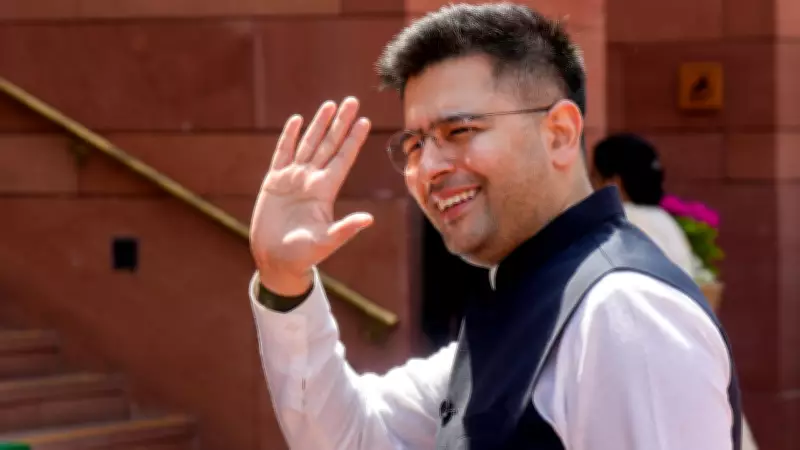
NEW DELHI: Just days before delivering his biggest political move yet, Raghav Chadha struck a cinematic note, invoking a Bollywood line from Dhurandhar: "ghayal hoon, isliye ghatak hoon" (I am wounded, therefore I am dangerous).
In hindsight, the dialogue and its metaphor now read very differently. The "wounded" leader Raghav Chadha has not just walked away from Arvind Kejriwal's AAP — he has crossed the political 'border' by joining the BJP. And in doing so, he may have inflicted the deepest wound yet on the AAP, proving to be the real lethal force for the party. More than a high-profile defection, Chadha's move, along with a clutch of Rajya Sabha members, strikes at the party's numbers, narrative, and national positioning. For AAP, the aftershocks are likely to be felt most sharply in Punjab, the only state where it holds full power and the foundation of its national ambitions.
"For the past few years, I could feel that I am the right man in the wrong party," Chadha said, explaining his decision.

Here are 5 reasons why Raghav Chadha's exit may hit AAP where it hurts the most:
1. Cost of this breakup in numbers
The exit of Raghav Chadha from the AAP is not just a political setback for the party; it delivers a sharp blow in pure numerical terms in Parliament. Chadha exited the party along with six other Rajya Sabha members. AAP's strength has effectively shrunk from 10 MPs to just 3, following the reported shift of seven members.
"We have decided that we, the two-thirds members belonging to the AAP in Rajya Sabha, exercise the provisions of the Constitution of India and merge ourselves with the BJP," Chadha said at a press conference, with Sandeep Pathak and Ashok Mittal on stage. "There are 10 AAP MPs in the Rajya Sabha, more than two-thirds of them are with us in this. They have signed, and this morning we submitted the signed letter and documents to the Rajya Sabha Chairman... three of them are here before you. Besides us, there are Harbhajan Singh, Rajinder Gupta, Vikramjit Singh Sahney and Swati Maliwal," he said.
Crossing the two-thirds mark allows the group to qualify as a merger under anti-defection rules, meaning the loss is both instant and irreversible. For AAP, that translates into a 70% drop in Upper House strength, severely limiting its ability to intervene in debates, secure committee positions, and shape national discourse. The setback is amplified by the fact that AAP's Rajya Sabha presence is largely rooted in Punjab — its only full-state power base. A weakened parliamentary bench reduces the party's ability to project Punjab's interests at the national level, even as it continues to govern the state.
2. 'New politics' brand takes credibility hit
While severing ties with the AAP, Chadha said: "The AAP, which I nurtured with my blood and sweat, and gave 15 years of my youth to, has deviated from its principles, values and core morals. Now this party does not work in the interest of the nation but for its personal benefits ... For the past few years, I could feel that I am the right man in the wrong party. So, today, we announce that I am distancing myself from the AAP and getting close to the public."
Since its inception in 2012 after the Anna Hazare movement, AAP's political strength has long rested on its ability to differentiate itself from traditional parties through a reformist, anti-establishment narrative. Chadha's exit complicates that positioning. By alleging that the party now works for "personal benefits" rather than the national interest, he can change the discourse in the coming months from promise to performance. The whole controversy around the liquor scam proved to be fatal for AAP in the 2025 assembly elections. Chadha's switch may also alter how voters interpret AAP's governance and intent in the upcoming Punjab elections.

Earlier in the month, in a cryptic post, Chadha had said: "Never outshine the master," suggesting that his rising national profile and perceived independence had made him a target within his own party. If he had gone to the BJP alone, the AAP leadership would have been able to put the entire blame on his loyalty. The breakaway of seven Rajya Sabha members together will at least raise a doubt in Kejriwal's leadership in the party. The leadership of the party has, however, blamed it on the BJP, alleging the saffron party conducted 'operation lotus' to divide the AAP.
3. Distancing 'aam aadmi' from Aam Aadmi Party
The damage is amplified by the fact that Chadha was not just a leader, but a symbol of the party's aspirational appeal to the youth and the common man. When AAP had removed Chadha from the post of deputy leader in Rajya Sabha, he had said: "Whenever I got a chance to speak in Parliament, I raised people's issues. Is raising public issues a crime? Don't consider my silence as my defeat."
In Rajya Sabha, Chadha raised a blend of high-level policy reforms and "everyday" consumer issues. His interventions often targeted the middle class, youth, and the gig economy. He raised issues like the 28-day mobile recharge "scam", airport food prices, 10-minute delivery safety, among others. The symbolism of Chadha's exit right now may hurt the 'aam aadmi' image of the party.
4. Architect of Punjab victory exits the stage
While Chadha's exit carries symbolic weight, the simultaneous departure of Sandeep Pathak may prove more consequential in structural terms. Widely seen as the architect behind AAP's Punjab victory, Pathak brought a data-driven, booth-level precision to the party's campaign machinery. His approach helped AAP convert roughly 42% vote share into a landslide majority of 92 seats of 117 in the 2022 assembly elections, a remarkable strike rate in a multi-cornered contest. Now, at a time when the Bhagwant Mann government is entering a crucial last-leg phase, with the assembly elections to be held next year, the absence of that strategic anchor could create a vacuum.
5. National positioning takes a hit
The fallout from Chadha's exit extends beyond Punjab into AAP's standing in national opposition politics. Within the INDIA bloc, the Aam Aadmi Party has positioned itself as a distinct force — often balancing cooperation with competition, especially with the Congress. That positioning now weakens after Chadha's exit. With its Rajya Sabha strength dropping sharply from 10 to 3, AAP's ability to project itself as a serious national player takes a direct hit. And in coalition politics, numbers are credibility.
This also affects AAP's leverage in the opposition's INDIA bloc dynamics. The party has often negotiated from a position of relative strength. That equation had already shifted a blow after last year's loss in Delhi. Now, as its legislative footprint shrinks, it might get harder for the party to assert itself in seat-sharing talks or strategic decisions.
For Chadha, the move resets his trajectory in national politics. Whether it strengthens the Bharatiya Janata Party's footprint in Punjab or reshapes opposition equations within the INDIA bloc will become clearer in the months ahead. One thing, however, is already evident: this is not just a break-up. It is a moment that could redraw political lines — both in Punjab and beyond.
Aam Aadmi Party leader Sanjay Singh has, for now, said he would seek the disqualification of Chadha, Ashok Mittal and Sandeep Pathak from the Upper House for joining the BJP.





