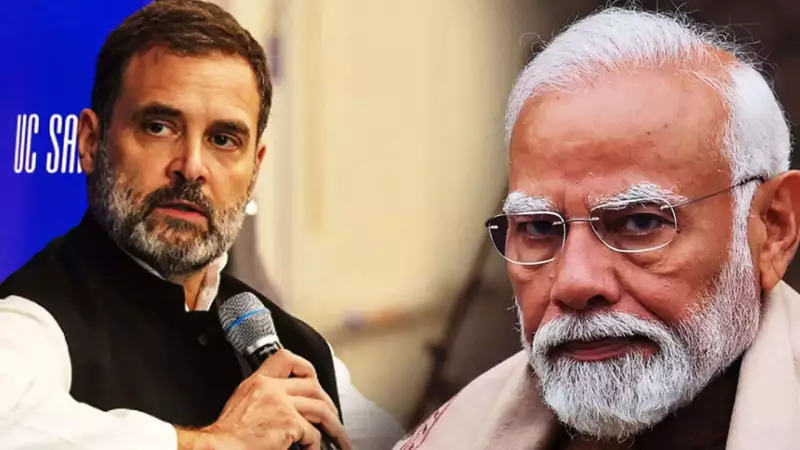
In a significant address on foreign soil, Lok Sabha Leader of Opposition Rahul Gandhi launched a sharp critique of the Narendra Modi-led government, highlighting critical economic and democratic challenges facing India. Speaking at the Hertie School in Germany on December 23, 2025, Gandhi framed his lecture, titled "Politics Is The Art Of Listening," as a warning about the nation's current trajectory.
Economic Critique: Outsourcing to China and Job Loss
Rahul Gandhi pinpointed a central flaw in India's economic model, accusing both Western nations and India of having "handed over production to China." He argued that this massive outsourcing has severely limited job creation within India, posing a long-term threat to the country's stability. Gandhi emphasized that true, large-scale employment can only be generated by strengthening core sectors.
Manufacturing, Micro, Small, and Medium Enterprises (MSMEs), and agriculture were highlighted as the essential pillars for building a robust job market. He noted with concern the declining share of manufacturing in India's Gross Domestic Product (GDP). To reverse this trend, the Congress leader called for urgent reforms in the Goods and Services Tax (GST) regime and broader industrial policies to support these sectors.

He also revisited the 2016 demonetisation move, condemning it for devastating small businesses and entrepreneurs across the country.
Institutional Weaponisation and Democratic Erosion
Moving beyond economics, Gandhi delivered a stern warning about the state of Indian democracy. He directly accused the ruling Bharatiya Janata Party (BJP) of weaponising central investigative agencies like the Central Bureau of Investigation (CBI) and the Enforcement Directorate (ED) to target and intimidate political opponents.
This practice, he asserted, is a direct attack on democratic principles and undermines the integrity of the country's institutional framework. Gandhi stressed that India's immense diversity cannot be governed by a monologue but requires continuous dialogue and listening to all states and communities.
A Clash of Two Visions for India
Rahul Gandhi framed the contemporary political struggle as a fundamental clash between two opposing visions for the nation's future. He positioned himself against the ideology of the Rashtriya Swayamsevak Sangh (RSS), the BJP's ideological parent, which he implied promotes a majoritarian and exclusionary view.
He warned that the current government's policies are leading to increased polarization and societal tensions, which risk weakening the constitutional and institutional foundations of the world's largest democracy. His speech in Berlin served as an international appeal for inclusive governance, where listening and dialogue prevail over centralised control and institutional coercion.