

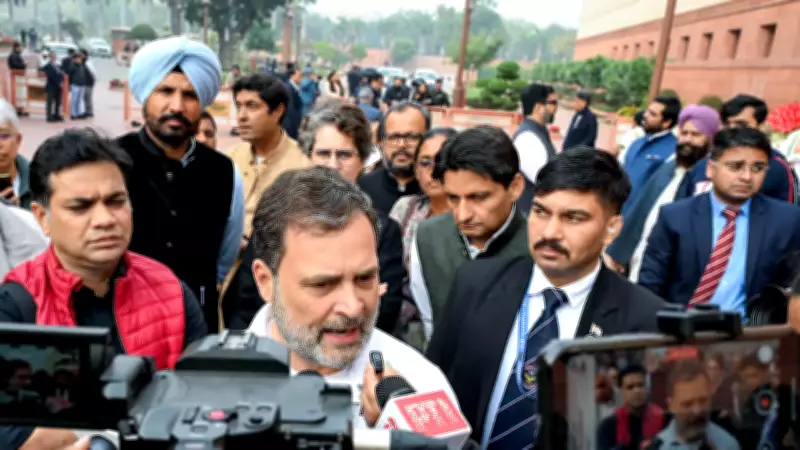
In a fiery confrontation outside Parliament on Tuesday, Leader of Opposition Rahul Gandhi unleashed a scathing attack on Prime Minister Narendra Modi, accusing him of being "compromised" and allegedly selling out India's hard-earned progress through the recently announced trade agreement with the United States.
Allegations of Pressure and Compromise
Addressing reporters, the Congress leader asserted that Prime Minister Modi signed the trade deal with the US "under immense pressure," suggesting that the agreement, which had been stalled for four months, was suddenly finalized due to undisclosed reasons known to both himself and the Prime Minister.
"Prime Minister Modi is rattled," Rahul Gandhi declared. "You saw that the trade deal which had been stalled for the last four months—nothing had changed for four months—for reasons I know and Narendra Modi knows, was suddenly signed by Narendra Modi yesterday evening."

Claims of a Bursting Image Bubble
Gandhi further claimed that there is "immense pressure" on Narendra Modi, warning that the carefully constructed image bubble of the Prime Minister, built through substantial financial expenditure, could potentially burst. He emphasized that the core issue transcends mere political slogans or statements.
"The main issue is that our Prime Minister has been compromised. Who has done it and how it has been done is for the people of India to think about," he added, framing the controversy as a matter of national concern.
Parliamentary Confrontation and Silencing
This outburst follows a contentious episode in Parliament where Rahul Gandhi was interrupted after quoting excerpts from the unpublished memoir of former Army chief General MM Naravane. The incident triggered objections from treasury benches, leading to opposition MPs raising slogans and the subsequent adjournment of proceedings.
Outside the House, Gandhi criticized the government for preventing him from speaking on the President's address, marking what he called an unprecedented denial of the Leader of the Opposition's parliamentary rights.
"For the first time in history, the Leader of the Opposition has not been allowed to speak on the President's address," he stated. "But you must understand this, and all the farmers of India must understand this: in this trade deal, Narendra Modi has sold your hard work, your blood and sweat. And he has done this because he is compromised. He hasn't just sold you; he has sold the country."
Identifying Pressure Points
Rahul Gandhi elaborated on what he described as the pressure points compelling the Prime Minister's actions. He asserted that Narendra Modi is "scared" because the very entities that built his public image are now allegedly dismantling it.
The Congress leader pointed to two specific pressure sources:
- Adani-related cases in the US: Gandhi highlighted the 1,111 cases against the Adani Group in the United States, arguing that these legal challenges are not merely targeting the business conglomerate but are effectively aimed at Narendra Modi's financial structure, given the perceived close ties between Adani and the BJP.
- The Epstein files: He referenced the unreleased material in the Epstein files, suggesting that the entire nation is eager to know their contents, and implied these documents contain potentially damaging information.
"So these are the two pressure points. And the country must understand this: the Prime Minister has been compromised, and that is the central issue," Gandhi concluded.
Background of Parliamentary Standoff
The current controversy stems from Monday's Lok Sabha session, which witnessed a major showdown after Defence Minister Rajnath Singh and Home Minister Amit Shah objected to Rahul Gandhi quoting from General Naravane's unpublished memoir.
The Congress leader maintained that the document he referenced was "authentic" and that he was exercising his parliamentary rights. He explained that he raised the issue only after BJP MP Tejasvi Surya questioned the Congress party's patriotism earlier in the debate.

"No debate on who is patriotic and who is not. Our patriotism is not buried," Gandhi asserted during the parliamentary exchange.
Rajnath Singh countered by stating that since the memoir had not been officially published, it could not be introduced into parliamentary proceedings, setting the stage for the ongoing political confrontation that has now expanded to include serious allegations about the US trade deal and the Prime Minister's integrity.





