

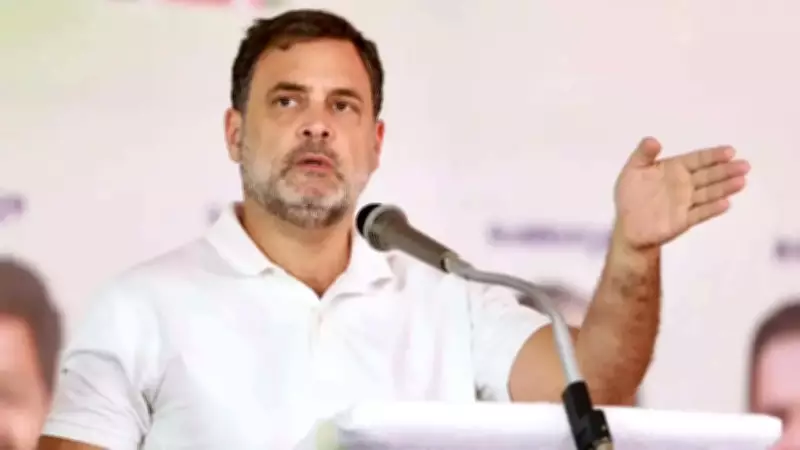
Rahul Gandhi Confronts Modi Government Over Missing Data on Contracts for Marginalized Communities
In a sharp parliamentary exchange, Congress leader Rahul Gandhi has demanded answers from the Modi government regarding the absence of official records tracking public works contracts awarded to businesses owned by Dalit, Adivasi, and Other Backward Classes (OBC) entrepreneurs. The controversy centers on contracts valued at over Rs 16,500 crore, with Gandhi accusing the Centre of perpetuating a "deliberately constructed system of exclusion" against Bahujan communities.
Parliamentary Query Reveals Data Gap
Through an unstarred question in the Lok Sabha, Gandhi sought detailed information on public works and infrastructure contracts awarded by the Central Public Works Department (CPWD) and under the Ministry of Housing and Urban Affairs over the past five years. Specifically, he inquired how many of these lucrative contracts were secured by enterprises owned by persons from Scheduled Castes (SC), Scheduled Tribes (ST), and OBC backgrounds.
In a written response, Minister of State for Housing and Urban Affairs Tokhan Sahu disclosed that while the government maintains year-wise data on the total number and value of contracts awarded, "there is no existing mechanism to track contracts awarded to enterprises owned by persons belonging to scheduled castes (SC), scheduled tribes (ST) and other backward classes (OBC)."

The government further clarified that all such contracts fall under construction contracts, and maintaining caste-based data is "not mandatory" for these procurements. When questioned about increasing procurement mandates for SC/ST-owned enterprises, the minister stated: "In view of the above, the question does not arise."
'Deliberate Exclusion' Allegation
Responding to the government's parliamentary reply on social media, the Leader of the Opposition labeled the situation as "deeply concerning." Gandhi emphasized that the government's Public Procurement Policy for MSMEs mandates that 25% of purchases by central ministries and public sector undertakings be sourced from micro, small, and medium enterprises, with 4% specifically earmarked for SC/ST-owned enterprises.
However, he pointed out a critical loophole: "When it comes to the largest and most lucrative contracts, public works, the government asserts that this requirement is not 'mandatory.'" Gandhi argued that this represents "not merely an administrative lapse; it is a deliberately constructed system of exclusion, fostered through the policies of the Modi government, that undermines social and economic justice."
The Congress leader posed a direct challenge: "The question is straightforward: Why are Bahujan entrepreneurs being excluded from the country's largest public contracts?"
Policy Disconnect and Transparency Concerns
The government's clarification reveals a significant policy disconnect. While MSME procurement rules include specific quotas for marginalized communities, these provisions do not apply to public works contracts—typically among the largest and most profitable government tenders. These contracts are awarded through open tendering processes, with no centralized database tracking the social category of contractors.
Gandhi's office highlighted that this data vacuum raises broader concerns about equitable access and transparency in government spending, particularly ahead of assembly elections in several states. The absence of monitoring mechanisms makes it impossible to assess whether marginalized communities are receiving fair participation in the nation's economic development through public contracts.
"The Modi government will have to answer for this," Gandhi asserted, framing the issue as one of fundamental social justice and economic inclusion.






