

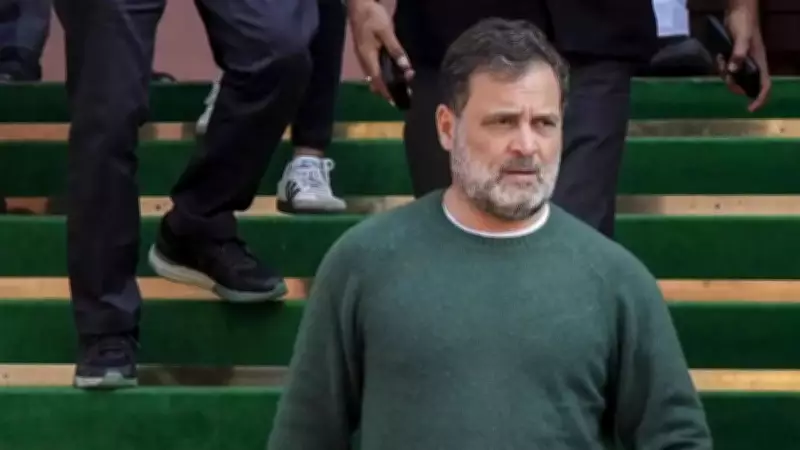
Rahul Gandhi Launches Fierce Attack on Modi Government Over Trade Agreement
NEW DELHI: In a dramatic parliamentary confrontation, Leader of the Opposition Rahul Gandhi delivered a scathing indictment of the Narendra Modi government on Wednesday, accusing it of what he termed a "complete surrender" of India's vital national interests through a controversial trade agreement. Speaking during the Budget discussion in Lok Sabha, Gandhi framed his criticism around what he described as the compromising of India's most critical assets in data, agriculture, and energy security.
Martial Arts Metaphor Targets PM Modi
Gandhi initiated his parliamentary address with an unconventional analogy drawn from martial arts, referencing the strategic concepts of "grip" and "chokehold" used to subdue opponents. He then applied this metaphor directly to what he characterized as the United States' handling of Prime Minister Modi, suggesting the Indian leader had capitulated under pressure due to leverage held by the foreign power.
The opposition leader's central thesis remained consistent throughout his speech: that the interim trade pact represents nothing less than a wholesale sellout of India's sovereign interests to external forces.

Three Pillars of National Security Compromised
Rahul Gandhi articulated three fundamental areas where he believes India's security has been dangerously compromised:
- Data Sovereignty: "The data of 140 crore Indians constitutes our nation's most valuable asset," Gandhi asserted, claiming this treasure trove of information has been effectively handed over through the agreement.
- Agricultural Vulnerability: "Our farmers have been abandoned to the mercy of mechanized American agricultural operations," he declared, painting a picture of Indian agriculture being overwhelmed by foreign competition.
- Energy Dependence: "Our energy security has been surrendered. We no longer possess the autonomy to purchase oil from our preferred sources," Gandhi lamented, suggesting strategic energy decisions have been outsourced.
"This represents nothing less than a wholesale surrender," Gandhi concluded emphatically, adding that India's textile industry has similarly been "wiped out" by the terms of the agreement.
Controversial Allegations and Parliamentary Pushback
The opposition leader's speech took several controversial turns that sparked immediate resistance from treasury benches. Gandhi made references to:
- A convicted child sex offender in the United States
- Two unnamed Indian businessmen
- Bharat Mata (Mother India) in a context that drew objections
These specific remarks were ultimately expunged from parliamentary records following intervention from the Chair, who directed Gandhi to refrain from leveling unsubstantiated allegations. The opposition leader had suggested that Petroleum Minister Hardeep Puri facilitated an introduction between an Indian businessman and the convicted offender, citing unnamed U.S. government files as evidence.
Contrasting Worldviews on Global Stability
Gandhi positioned his critique within a broader geopolitical framework that directly contradicts the government's official stance. While Prime Minister Modi and National Security Advisor Ajit Doval have consistently promoted the message that "this is not an era of war," Gandhi presented a starkly different assessment.
"The world is in fact moving decisively into an era of war and instability," Gandhi countered, pointing to intensifying global conflicts and shifting power dynamics. He noted the increasing challenges to U.S. dollar supremacy and the gradual transition away from a unipolar world dominated by a single superpower.
Budget Critique and Policy Vacuum
The opposition leader acknowledged that the government's budget document recognizes certain contemporary challenges, including what he described as "the weaponization of energy and finance" in international relations. However, he criticized what he perceives as a failure to propose concrete pathways forward.

Gandhi's comprehensive attack struck at what has traditionally been a strong political plank for the BJP-led NDA government since its 2014 ascension to power: the robust defense of national interests in international negotiations. By framing the trade agreement as a betrayal of these very principles, Gandhi sought to turn the government's perceived strength into a vulnerability during the crucial budget session.
The parliamentary exchange highlights deepening political divisions over India's economic diplomacy and sets the stage for continued confrontation between the government and opposition on matters of national sovereignty in an increasingly complex global landscape.





