

Rahul Gandhi Intensifies Critique of RSS and BJP on Social Justice Issues
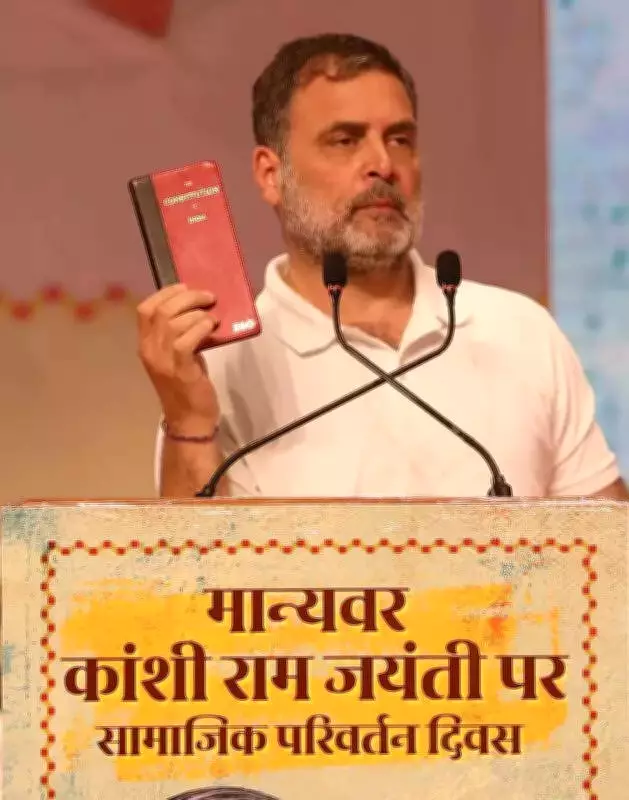
Congress MP from Rae Bareli, Rahul Gandhi, on Friday escalated his criticism of the Rashtriya Swayamsevak Sangh (RSS) and the Bharatiya Janata Party (BJP), centering the political discourse on themes of social justice and constitutional values. Speaking at the Samvidhan Sammelan in Lucknow, Gandhi asserted that the senior leadership of the RSS lacks adequate representation from Other Backward Classes (OBCs), Dalits, and Adivasis, framing this as a reflection of broader power imbalances in India.
Addressing Power Imbalances and Social Inclusion
Gandhi emphasized that a review of the RSS's top organizational structure and senior functionaries reveals the absence of these marginalized communities. He argued that this exclusion mirrors a wider disparity in the country's power dynamics, stating, "The contest in Indian politics is now clearly between those seeking broader inclusion and those preserving concentration of power." His remarks were delivered to party workers, where he also commemorated the birth anniversary of Dalit leader Kanshi Ram, praising his enduring legacy in Indian politics.
Highlighting Kanshi Ram's Legacy and Underrepresentation
Reflecting on Kanshi Ram's contributions, Gandhi noted that the late leader's vision was rooted in ensuring progress benefits the majority, including the most marginalized sections of society. He pointed out that India's major institutions, such as the judiciary, bureaucracy, cabinet, education system, and corporate sector, still fail to reflect the nation's social composition. According to Gandhi, large segments of the population, particularly Dalits, Adivasis, backward classes, extremely backward groups, and minorities, remain underrepresented in positions of power and decision-making.

Congress's Ideological Stance and Political Strategy
Gandhi positioned the Congress party as an ideological force drawing strength from the legacies of Mahatma Gandhi, B.R. Ambedkar, and Jyotiba Phule. He asserted, "Such a party cannot be defeated if it stays committed to its path and values." Urging party workers to move beyond mere slogans, he stressed the importance of ideological commitment and sustained political struggle, citing examples from Ambedkar and Kanshi Ram, who remained steadfast in their principles without compromise.
Constitutional Values and Broader Political Attacks
Describing the Constitution as more than a legal document, Gandhi highlighted that it embodies the voices and values of reformers like Ambedkar, Mahatma Gandhi, Narayana Guru, Basavanna, and Gautam Buddha, rather than ideologues such as V.D. Savarkar or Nathuram Godse. He announced the Congress party's commitment to pushing for caste enumeration and greater inclusion of marginalized communities in India's power structure, making this a central theme in their campaign.
Additionally, Gandhi launched broader political attacks on Prime Minister Narendra Modi, alleging compromises on national issues like energy security, economic policy, and the concentration of financial influence. The event concluded with a proposal from participants seeking a posthumous Bharat Ratna for Kanshi Ram, which received widespread support, with workers expressing hope for the honor if Rahul Gandhi becomes Prime Minister.






