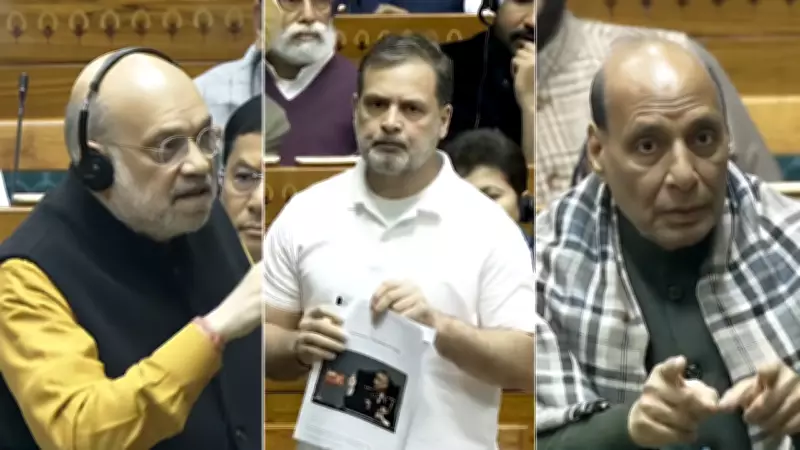
The Lok Sabha witnessed intense parliamentary drama on Monday, just one day after the presentation of the Union Budget, as a major confrontation unfolded during the Motion of Thanks on the President's Address. The session turned particularly contentious when Lok Sabha leader of opposition Rahul Gandhi rose to speak, triggering what would become one of the most fiery exchanges in recent parliamentary history.
Unpublished Memoir Sparks Immediate Objections
As Rahul Gandhi began his address, he made reference to the unpublished memoir of former Army chief General MM Naravane, a move that immediately drew strong objections from senior government ministers. Union home minister Amit Shah and defence minister Rajnath Singh both rose simultaneously to protest, arguing forcefully that unpublished material could not be cited in the House according to established parliamentary rules and procedures.
Speaker's Ruling and Gandhi's Defiance
Following these objections, the Speaker ruled against Gandhi quoting from a magazine article that carried excerpts from the unpublished memoir. Undeterred, the Congress leader questioned the basis of these objections, asking pointedly, "What does it contain which is scaring them so much? If they are not scared, I should be allowed to read on," after having raised issues related to China in his address.

The situation escalated as Gandhi sought to justify his reference to the memoir, stating, "The defence minister, home minister and the Prime Minister raise questions on our party, party leaders, and our nationalism. This article writes about the PM's character...This is neither about China, nor the PM..." His remarks came in response to repeated interventions by Shah and Singh, as well as the Speaker's rulings on the matter.
Parliamentary Affairs Minister Enters the Fray
Parliamentary affairs minister Kiren Rijiju later joined the debate, countering Gandhi's remarks with a firm stance on parliamentary decorum. He emphasized, "The Speaker has given a ruling that articles from magazines or newspapers cannot be quoted in the House...Debate in the House should be held according to the laws." This intervention added another layer to the already heated exchange.
Despite being repeatedly interrupted by senior ministers, Rahul Gandhi maintained his position, asserting that his references to Naravane's memoir were "100 percent authentic" and defending his right to raise what he considered important matters of national interest.
Earlier Contrast in Parliamentary Speeches
Earlier in the day, before this dramatic exchange, BJP MP Tejasvi Surya had set a different tone while seconding the Motion of Thanks on the President's Address. He described the Congress-led UPA government's tenure from 2004 to 2014 as a "decade of lost opportunities" and a "narrative of excuses" for failing on multiple fronts. Surya argued that the contrast between what he called "weak leadership" and "great leadership" clearly differentiated the Congress and the BJP approaches to governance.
The Budget Session of Parliament thus began with significant political theater, highlighting the deep divisions between the ruling party and the opposition. The clash over parliamentary procedures and the content of speeches underscored the ongoing political tensions that characterize India's legislative proceedings, particularly during important sessions like the Budget discussion.