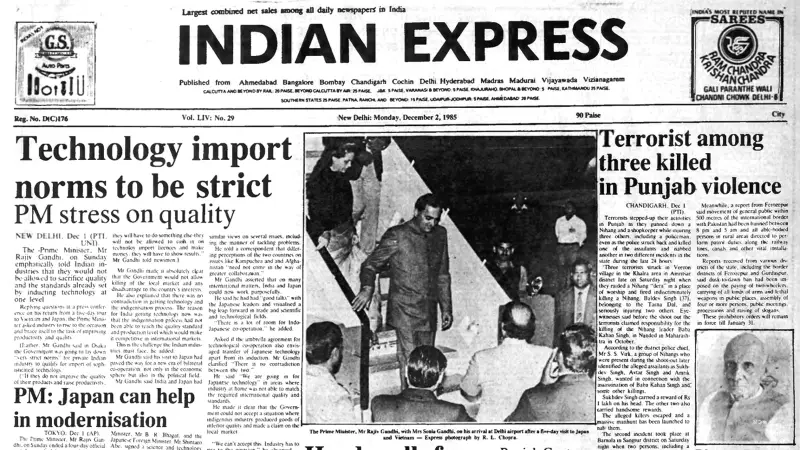
December 2, 1985, was a day that captured several critical threads of India's political and social fabric, from economic policy and press freedom to regional unrest and political protest. The front page of The Indian Express from that date reveals a nation at a crossroads, with its leadership making decisive moves.
Rajiv Gandhi's Firm Stance on Technology and Quality
Prime Minister Rajiv Gandhi delivered a clear message to Indian industries regarding the import of foreign technology. Speaking earlier in Osaka, he had indicated the government's intention to establish "very strict norms" for private companies seeking to bring in sophisticated technology from abroad.
On this day, he emphatically reinforced that position. Gandhi stated that industries would not be permitted to compromise on quality or lower existing standards simply by introducing technology at a basic level. His objective was unambiguous: to protect and nurture the domestic market from being undermined by substandard technological adoption. The government's policy aimed to ensure that technology imports genuinely enhanced India's industrial capabilities without killing local innovation and production.

Calls for Stronger Defamation Laws
In a significant address concerning media freedom, Karnataka Chief Minister Ramakrishna Hegde advocated for more stringent libel laws. He delivered this call during the Seventh Bhimsen Sachar Memorial Lecture on "Freedom of Media" at Lajpat Bhawan in New Delhi.
Hegde argued that the existing defamation laws were ineffective, lacking the necessary "teeth" to deter misuse of press freedom. He highlighted the protracted nature of such legal battles, where both parties suffered regardless of the eventual outcome, assuming the case was ever resolved. His lecture sparked a debate on balancing press freedom with accountability.
Violence and Political Unrest Across States
The day's news also reported escalating tension in Punjab. Terrorists intensified their activities, resulting in the deaths of a Nihang and a shopkeeper. Three other individuals, including a policeman, were injured. In response, police forces engaged the assailants, killing one terrorist and capturing another in two separate incidents within a 24-hour period.
In Odisha, a dramatic political confrontation unfolded. Former Chief Minister Nandini Satpathy was arrested and later released after a day in custody at the Bhubaneswar police headquarters. The arrest was forceful; she was physically lifted and placed into a police vehicle at the state secretariat. She had been leading a group of approximately 200 Opposition workers protesting a hike in bus fares.
The arrest caused confusion and alarm. Opposition leaders, such as the CPI's Loknath Chaudhary, who could not locate Satpathy, sent a telegram to the Prime Minister alleging foul play in her sudden disappearance. The police crackdown was broad, resulting in the arrest of 148 Opposition workers involved in the protest.
A Snapshot of a Nation in Transition
The events of December 2, 1985, collectively paint a picture of a government attempting to steer economic modernization with caution, a political class grappling with the limits of free expression, and a country facing persistent challenges to law and order. Prime Minister Gandhi's tech import norms were part of a broader vision for a self-reliant yet technologically advanced India, while the incidents in Punjab and Odisha underscored the complex realities of governance and dissent during that era.