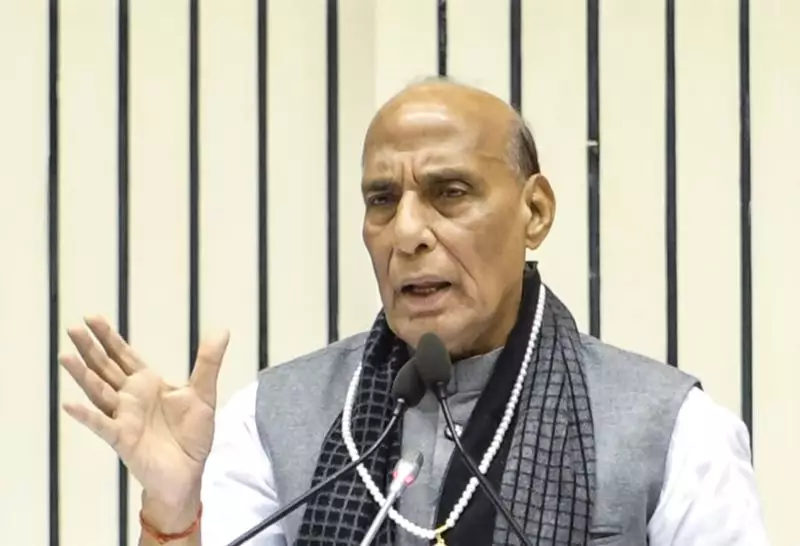
Defence Minister Rajnath Singh has made a significant revelation about a critical military operation along the India-China border, highlighting the strategic restraint exercised by the nation's armed forces. Speaking at an event, Singh stated that while Indian troops possessed the capability to achieve far more during 'Operation Sindoor,' they consciously chose a path of moderation to prevent a larger conflict.
The Context of Operation Sindoor
The Defence Minister's comments came during the 'Shaurya Diwas' celebrations held in Jammu, an event commemorating the landing of the first Indian Army contingent in Jammu and Kashmir in 1947. While addressing the gathering, Singh drew a parallel between the historic bravery shown then and the courage displayed by today's soldiers in defending the nation's borders. He specifically pointed to the situation in the Tawang sector of Arunachal Pradesh, a region that has witnessed heightened tensions and clashes between Indian and Chinese troops in recent years.
Operation Sindoor is understood to be the code name for a specific military action undertaken by the Indian Army in the Tawang sector. Although Singh did not elaborate on the exact date or precise tactical details of the operation, his statement confirms a proactive and robust Indian military response to Chinese incursions or aggressive posturing. The minister's words underscore that the operation was a measured success achieved through calculated discretion.

Strategic Restraint as a Deliberate Choice
Rajnath Singh's core message centered on India's mature and responsible approach to border management. He emphasized that the Indian armed forces are fully capable of delivering a much stronger response when provoked. "Our forces could have done much more during Operation Sindoor," Singh asserted, leaving little doubt about the military's offensive potential.
However, he clarified that the government's directive and the forces' own judgment prioritized preventing a full-scale escalation. This restraint, according to the Defence Minister, was a conscious strategic decision. It reflects a policy where military might is balanced with diplomatic wisdom, aiming to secure borders without unnecessarily sparking a wider conflagration. This approach aligns with India's stated position of maintaining peace and tranquility along the Line of Actual Control (LAC) while being firmly committed to protecting its territorial integrity.
Broader Message on National Security and Resolve
The Defence Minister used this revelation to send a clear, dual-purpose message. First, it serves as a reassurance to the Indian public about the prowess and capability of the armed forces. Second, and perhaps more importantly, it acts as a signal to adversaries about India's confidence and the deliberate choice for peace, which should not be mistaken for weakness.
Singh reiterated that the nation's security remains paramount and that the government stands firmly behind its soldiers. He praised their valor and sacrifice in the challenging conditions of the high Himalayas. The reference to Operation Sindoor, while not detailing the operation itself, is seen as an affirmation that India is actively and effectively countering Chinese maneuvers along the disputed border.
The statement comes amidst ongoing military and diplomatic talks between India and China to resolve the standoff that began in Eastern Ladakh in 2020. While the eastern sector (including Tawang) has seen separate flare-ups, the broader context remains one of strained relations and a heavy military deployment on both sides. Singh's comments reinforce India's stance that it will respond firmly to any attempts to alter the status quo unilaterally, but will do so with a level of responsibility that seeks to manage escalation.
In conclusion, Defence Minister Rajnath Singh's disclosure about Operation Sindoor provides a rare glimpse into the on-ground dynamics at the India-China border. It highlights a successful military action defined not by maximalist aggression, but by controlled and effective response. The narrative builds on the government's image of handling national security with a blend of strength and strategic sagacity, ensuring the country's interests are protected without courting avoidable conflict.