

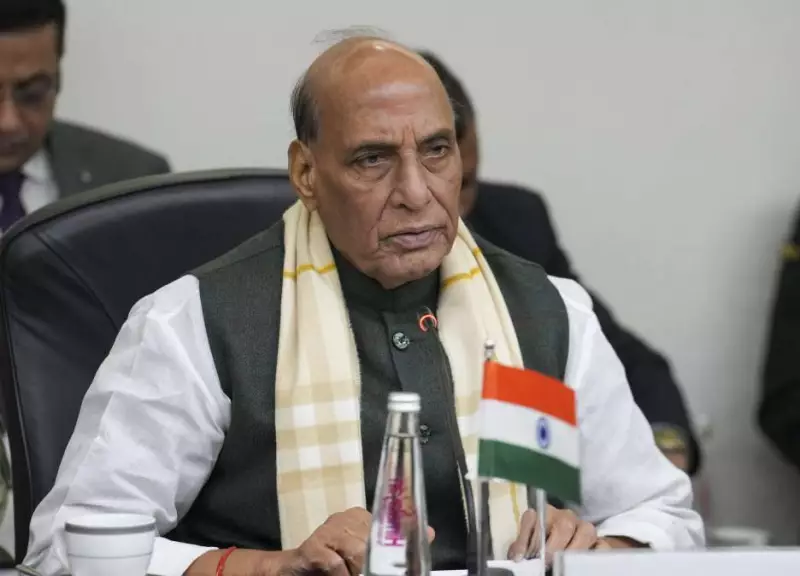
Defence Minister Rajnath Singh has ignited a fresh political controversy with a significant historical claim. He asserted that India's first Prime Minister, Jawaharlal Nehru, had sought public funds for the construction of the Babri Masjid in Ayodhya in 1949. This statement was made during a public address in Uttar Pradesh's Ghazipur district on Tuesday, December 3, 2024.
The Core Allegation and Historical Context
Rajnath Singh, a senior leader of the Bharatiya Janata Party (BJP), presented what he described as a historical fact. He claimed that after India gained independence, Jawaharlal Nehru wrote a letter to the then Uttar Pradesh Chief Minister, Govind Ballabh Pant. In this purported communication, Nehru allegedly requested the allocation of public funds for building the Babri Masjid in Ayodhya.
The Defence Minister stated that this letter is preserved in the National Archives, challenging the Congress party to either accept or deny the existence of this document. He framed this revelation as part of a broader critique of the Congress party's historical stance on religious issues, accusing them of practicing appeasement politics for decades.

Political Reactions and Immediate Fallout
The claim has predictably triggered a sharp response from the opposition, particularly the Congress party. Congress leaders have vehemently denied the allegation, labeling it as "baseless" and "a desperate attempt to rewrite history." They have demanded that Rajnath Singh produce the letter as concrete evidence to support his statement.
This incident is not occurring in a vacuum. It comes at a time of heightened political activity in Uttar Pradesh and adds a new layer to the long-standing and sensitive debate surrounding the Ayodhya dispute. The site, where the Babri Masjid stood until its demolition in 1992, is now home to the newly constructed Ram Mandir, a project heavily championed by the BJP and allied groups.
Broader Implications and Analysis
Rajnath Singh's statement serves multiple political purposes. Firstly, it directly targets the legacy of Jawaharlal Nehru and the Congress party, attempting to paint them as being selectively supportive of minority interests using state resources. Secondly, it reinforces the BJP's narrative of correcting historical wrongs and opposing what it terms as "pseudo-secularism."
The timing of the remark is also crucial. With the political landscape constantly evolving, such historical assertions are aimed at consolidating the party's core support base. The demand for the Congress to clarify its position puts the opposition on the defensive, forcing them to engage on a topic charged with historical and religious sentiment.
As of now, the controversy continues to unfold. Historians and political analysts are likely to scrutinize the archives for the letter mentioned by the Defence Minister. The veracity of this claim will significantly impact its political resonance. Regardless of the document's existence, the statement has successfully shifted the political discourse, once again bringing historical interpretation and religious symbolism to the forefront of national politics.






