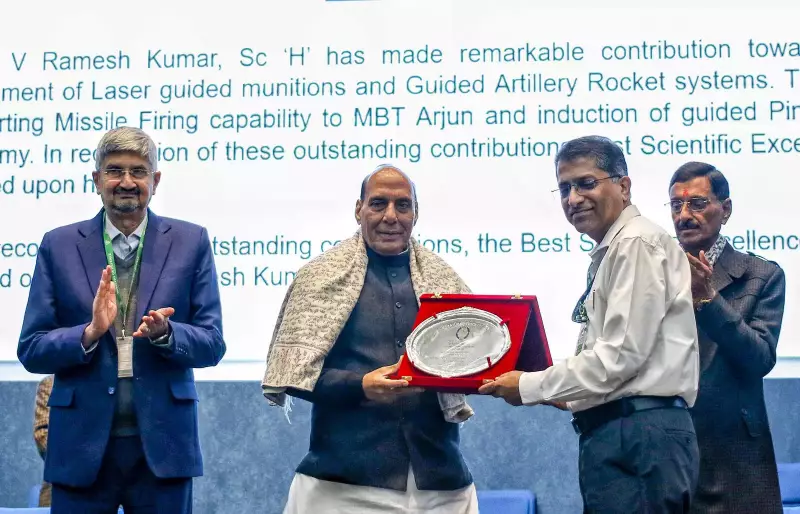
New Delhi: Defence Minister Rajnath Singh on Tuesday commended the scientists of the Defence Research and Development Organisation (DRDO) for their pivotal role in fortifying India's strategic capabilities through the development of advanced tanks, missiles, and rocket systems. However, he advised them to "increase your appetite for risk in research" to drive innovation further.
Emphasizing Speed and Strategic Advantage
Highlighting the critical importance of rapid technological advancement, Singh pointed out that "the country that thinks, decides and deploys technology quickly stays ahead." He noted that DRDO's technology was effectively utilized on the battlefield during Operation Sindoor, underscoring the agency's key role in the rapid transformation of the defence sector, driven by the pursuit of indigenisation.
DRDO-developed systems, including the D-4 anti-drone system, smart anti-airfield weapon, and Akash air defence system, played critical roles in the operation last year, demonstrating their operational effectiveness.

Call for Enhanced Collaboration and Risk-Taking
The minister suggested that defence scientists should "increase your cooperation with the public and PSUs and share your knowledge with them... We should step out of the conventional areas." He proposed the creation of a "separate wing" within DRDO that "takes risks in sectors where the chances of success may seem low." Singh emphasized that if success is achieved in such high-risk areas, it would be historic, potentially yielding groundbreaking advancements.
Accelerating Research-to-Deployment Timelines
Rajnath Singh underlined the "need to reduce time" between research and prototype development, from prototype to testing, and from testing to deployment. He asserted that "timely induction in the armed forces should be the biggest parameter." In today's fast-evolving technological landscape, he warned that "any tech that is new today may become irrelevant in four to five years."
Therefore, he stressed the importance of moving forward with the theory of "survival of the fastest" rather than just "survival of the fittest," especially on the modern battlefield where speed is paramount.
DRDO's Growth and Recent Achievements
The minister praised DRDO for its remarkable journey from 10 laboratories at its inception to 45 labs today, stating that the organisation has significantly strengthened India's self-reliance in defence and meets global standards. DRDO has significantly accelerated its advanced weapons programmes and missile testing pace, conducting multiple trials within a short span of 40 days to bolster deterrence capabilities.
Recent achievements include:
- Testing two Pralay quasi-ballistic missiles in quick succession.
- Testing India's first long-range hypersonic missile (1,500km) in December last year.
- Conducting a ground test of its scramjet combustor for hypersonic cruise missile this month.
Akash Air Defence System Upgrades
Meanwhile, Ankathi Raju, director of DRDO's lab DRDL, provided insights into the Akash air defence system upgrades. He stated, "Akash's first version has already been inducted in the Army and IAF. It was successfully used during Op Sindoor and has a range of 25km."
He elaborated on the advancements:
- AkashPrime is an upgraded version with the same range but designed for use in high-altitude areas.
- AkashNG is the most advanced version with a maximum range of 50 km, and its user trials have been completed.
These developments highlight DRDO's ongoing efforts to enhance India's defence capabilities through continuous innovation and strategic upgrades.