

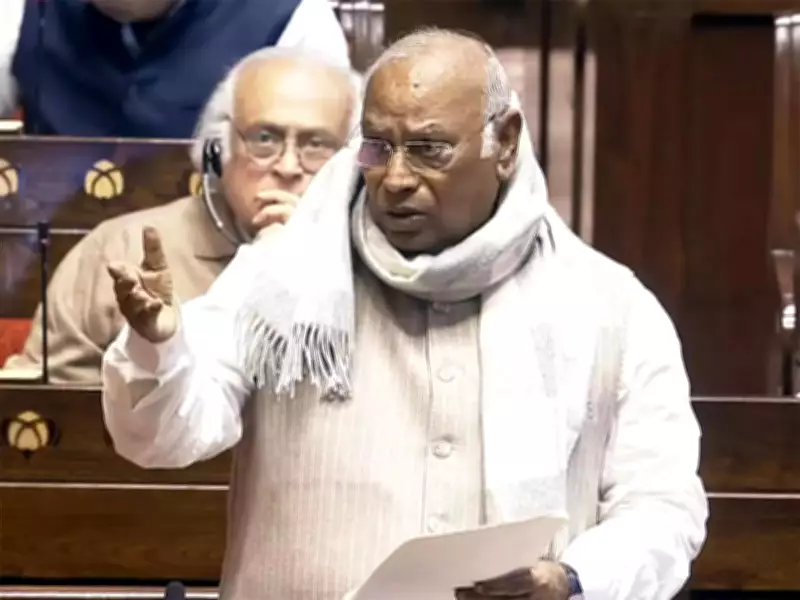
Rajya Sabha Sees Heated Exchange Over Attack on Farooq Abdullah
The Rajya Sabha witnessed a sharp confrontation between the opposition and treasury benches on Thursday, triggered by leader of the opposition Mallikarjun Kharge raising the recent attack on former Jammu and Kashmir chief minister Farooq Abdullah. The session quickly descended into political sparring, with both sides trading accusations over responsibility for the incident.
Kharge Blames Centre for Law and Order Failure
Initiating the debate, Mallikarjun Kharge directly blamed the central government for what he described as a deteriorating law and order situation in the country. "The entire responsibility for security and policing rests with the home ministry," Kharge asserted. He emphasized that such attacks raise serious questions about the effectiveness of governance and security apparatus under the current administration.
Kharge further argued that incidents targeting prominent political figures like Farooq Abdullah undermine public confidence in the state's ability to protect its citizens. His remarks were pointedly critical, suggesting a systemic failure in maintaining order and safety.

Nadda Dismisses Link to Statehood, Assures Serious Action
Responding to Kharge's allegations, leader of the House and BJP president J P Nadda firmly dismissed any attempt to link the attack to broader political issues like statehood. He termed the incident a matter of "great concern" and assured the House that the Centre is treating it with the utmost seriousness.
Nadda stated, "This attack is a matter of serious concern, and we assure the House that the government is taking all necessary steps to address it." He emphasized that the focus should remain on the security aspects rather than politicizing the event, urging for a unified approach in condemning violence.
Broader Context of Regional and Global Tensions
The debate occurred against a backdrop of heightened global tensions, including updates on the Israel-Iran conflict, which saw Saudi Arabia intercepting a drone headed to the Shaybah oil field and Israeli strikes on Hezbollah targets in Beirut. Additionally, Iran issued warnings to US tech firms like Google, Amazon, Microsoft, and Nvidia, labeling them as "legitimate targets," while providing safe passage for Indian-flagged vessels in the Hormuz Strait, contrasting with restrictions on US, European, and Israeli ships.
This international context subtly influenced the domestic discourse, with implications for India's diplomatic and security strategies. The Rajya Sabha session highlighted how local incidents can resonate with broader geopolitical dynamics, affecting national and regional stability.
Implications for Governance and Security
The exchange underscores ongoing tensions between the opposition and government over governance and security issues. Key points from the debate include:
- The opposition's insistence on holding the Centre accountable for law and order failures.
- The government's reassurance of taking the attack seriously while avoiding political linkages.
- The need for robust security measures to protect public figures and maintain order.
- The interplay between domestic incidents and international conflicts, affecting policy responses.
As the session concluded, both sides reiterated their positions, with Kharge demanding concrete action and Nadda promising thorough investigations. The incident has sparked a renewed debate on security protocols and political accountability in India's parliamentary framework.






