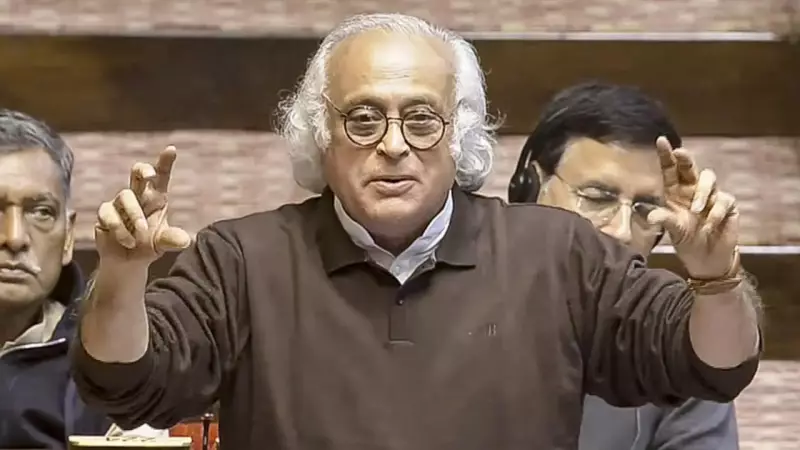
Congress General Secretary Jairam Ramesh has escalated the political and environmental debate surrounding the Aravalli hills, directing a pointed letter to Union Environment Minister Bhupender Yadav. This move comes just a day before the Supreme Court is scheduled to hear a suo motu civil case concerning the controversial new definition of the Aravalli hills and ranges.
Four Critical Questions on Aravalli Assessment
In his communication dated Sunday, Ramesh posed four specific questions to the minister. He focused on the assessment conducted by the Forest Survey of India (FSI) and the views expressed by a member of the Central Empowered Committee (CEC). The Congress leader argued that adopting the new definition would fragment and severely undermine the geographical and ecological integrity of the entire Aravalli range.
Ramesh highlighted widespread public and expert concern over the redefinition, which reportedly restricts the classification of Aravalli hills to landforms with an elevation of 100 meters or more. This shift, he contends, ignores the vital protective role played by smaller hill formations.

Contradictory Claims and Official Clarifications
The Environment Ministry has previously sought to allay fears, stating that a uniform definition would exclude only a small fraction—approximately 0.2%—of the Aravallis from protection, potentially opening them for mining. Furthermore, on December 23, the FSI itself refuted claims that it had conducted a study suggesting 90% of the hills would lose protection following a November 20 Supreme Court judgment.
Despite these clarifications, Ramesh's letter presses for accountability. He directly questioned whether it was a fact that the FSI, in a September 20, 2025 communication to the ministry, had stated that "smaller hill formations of the Aravallis serve as natural barriers against desertification." The FSI note emphasized that even modest hills of 10 to 30 meters act as strong natural windbreaks, as their protective effect scales directly with height.
Historical Definition and Mining Leases at Stake
Ramesh further probed the historical context of the definition. He asked the minister to confirm if the definition used in Rajasthan since 2012 was based on an FSI report from August 28, 2010. That report defined hills as "all such areas having a slope of 3 degrees or more." This older, topographical definition is far more inclusive than the new elevation-based criterion.
The Congress leader's final question touched on a critical finding by the Supreme Court's own CEC. He sought confirmation that the CEC, in its November 7, 2025 report, concluded that 164 mining leases in Rajasthan were located inside the Aravalli Hills and Ranges as defined by the then-prevailing FSI definition. This raises significant questions about the potential impact of the definition change on these existing leases and future ecological conservation efforts.
The timing of this letter ensures the issue remains at the forefront of legal and environmental discourse as the Supreme Court prepares to examine the matter. The outcome could have lasting implications for the protection of one of North India's most crucial ecological shields.