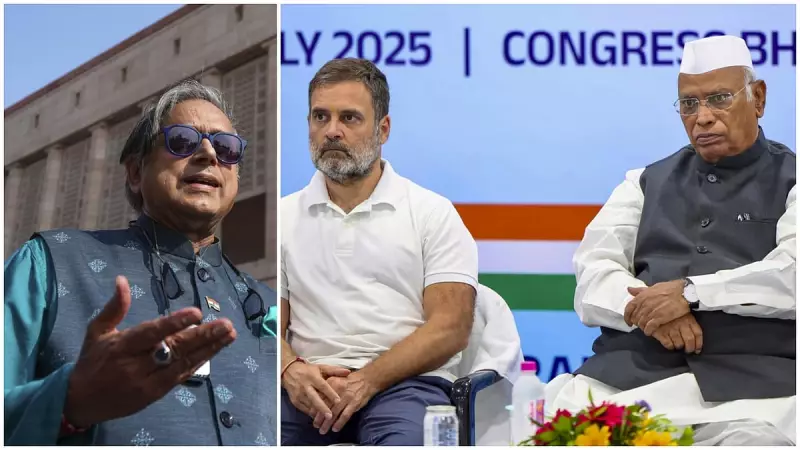
A political controversy has erupted over the guest list for an official banquet dinner being hosted by Prime Minister Narendra Modi for visiting Russian President Vladimir Putin. The Congress party has taken a sharp swipe at its own senior leader, Shashi Tharoor, for accepting an invitation to the event, while party chief Mallikarjun Kharge and former president Rahul Gandhi were reportedly not invited.
The Core of the Controversy
The dispute centers on the selective nature of the invitations. According to reports, Shashi Tharoor, the Congress MP from Thiruvananthapuram, received and accepted an invitation to attend the high-profile diplomatic banquet. However, the top leadership of the Congress party, including President Mallikarjun Kharge and key figure Rahul Gandhi, did not receive similar invites. This discrepancy prompted an immediate and critical reaction from within the Congress ranks.
The party was quick to question the motives behind the invitation. In a pointed statement, Congress suggested that one must understand "why the game is being played" by the Modi government. They urged individuals to question their own conscience and listen to it when deciding to participate in such events, implying a political strategy behind the selective outreach.
Congress's Stance and Internal Tensions
The public criticism of Tharoor highlights potential internal tensions and the party's broader narrative against the ruling Bharatiya Janata Party (BJP). By framing the invitation as a "game," Congress aims to portray the Modi administration as attempting to create divisions within the opposition or to legitimize the event through cross-party attendance while sidelining its primary leadership.
The incident, reported on December 5, 2025, adds another layer to the complex dynamics of Indian politics, where diplomatic gestures are often scrutinized for domestic political undertones. The Congress's reaction suggests a view that accepting the invite could be seen as endorsing the government's foreign policy or political stance, a move they are keen to counter.
Broader Political Implications
This row transcends a simple dinner invitation. It touches upon several key aspects of political strategy:
- Opposition Unity: Testing the cohesion within the Congress party when its members are approached individually by the ruling dispensation.
- Political Messaging: Allowing Congress to reinforce its position as a principled opposition questioning the government's actions.
- Diplomacy and Politics: Blurring the lines between a state diplomatic function and domestic political maneuvering.
The development puts Shashi Tharoor in a delicate position, balancing his role as a parliamentarian invited to a national event with his allegiance to the party line. As of now, Tharoor is slated to attend the banquet, setting the stage for further discussion within political circles. The episode underscores how in the Indian political landscape, even a dinner invitation can become a focal point for major political debate and positioning.