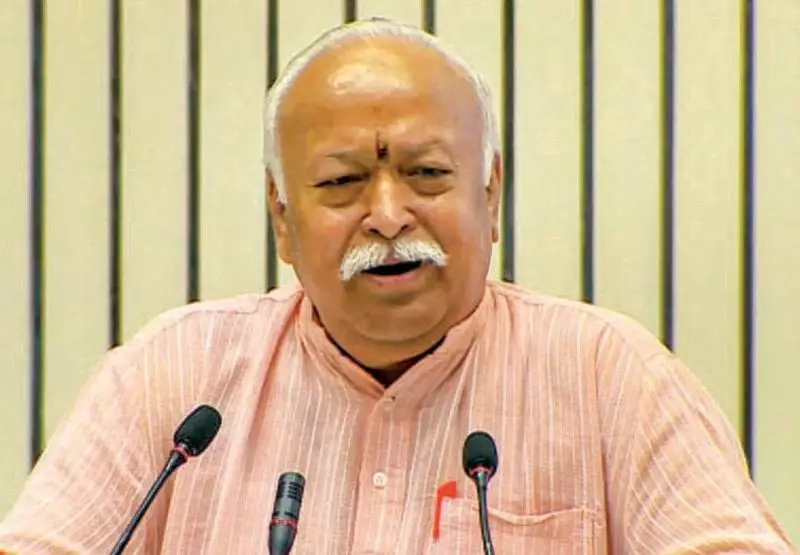
Rashtriya Swayamsevak Sangh (RSS) chief Mohan Bhagwat, in a significant address, invoked Mahatma Gandhi to counter a long-standing historical narrative. He stated that the British colonial rulers deliberately created a false perception that India lacked unity before their arrival.
Gandhi's Perspective on Colonial Propaganda
Speaking at an event in Nagpur, Bhagwat referenced Gandhi's views on the matter. He emphasized that the Father of the Nation believed the British propagated the idea of Indian disunity to justify their colonial rule. This narrative, Bhagwat argued, was a strategic tool used to undermine the inherent cultural and social cohesion that existed in Indian society for centuries.
The RSS chief's remarks were made during the launch of a book titled 'A Journey of Dreams: From an Empire to a Divine Nation'. He used the platform to delve into historical interpretations and their impact on national consciousness. Bhagwat pointed out that this foreign-originated theory of inherent division has had a lasting impact, sometimes overshadowing the deep-rooted unity found in India's diverse cultural landscape.

The Call for Confidence and Self-Reliance
Beyond the historical analysis, Bhagwat's speech carried a forward-looking message. He called for a renewed sense of self-confidence among Indians. He stressed that the nation must move forward with the firm belief in its own capabilities and inherent strength. A key part of this vision, according to him, is achieving self-reliance or 'Atmanirbharta', which he described as a crucial pillar for national progress and dignity.
Bhagwat elaborated that true self-reliance is not just economic but also intellectual and cultural. It involves trusting indigenous knowledge systems and fostering a spirit of innovation rooted in Indian values. This confidence, he suggested, is essential to fully shed the lingering effects of colonial mindset and narratives.
Cultural Unity as India's Foundation
A major thrust of the address was the concept of unity in diversity. Bhagwat asserted that India's ancient culture has always acted as a unifying force, binding its numerous communities, languages, and traditions. The colonial portrayal of a fractured subcontinent, he contended, ignored this profound cultural continuity and shared civilizational ethos.
He argued that recognizing this cultural unity is fundamental to understanding India's true identity. The RSS chief's comments are seen as part of a broader discourse aimed at promoting a cultural-nationalist perspective on Indian history and society, one that challenges interpretations perceived as stemming from a colonial viewpoint.
In conclusion, Mohan Bhagwat's Nagpur address served multiple purposes: it offered a historical critique of British colonial rhetoric through the lens of Gandhi's opinion, advocated for a culturally grounded national self-confidence, and reinforced the call for comprehensive self-reliance. The invocation of Gandhi on this particular issue is a notable aspect of his speech, linking the thoughts of a pivotal figure in India's freedom struggle to contemporary debates about national identity and historical narrative.