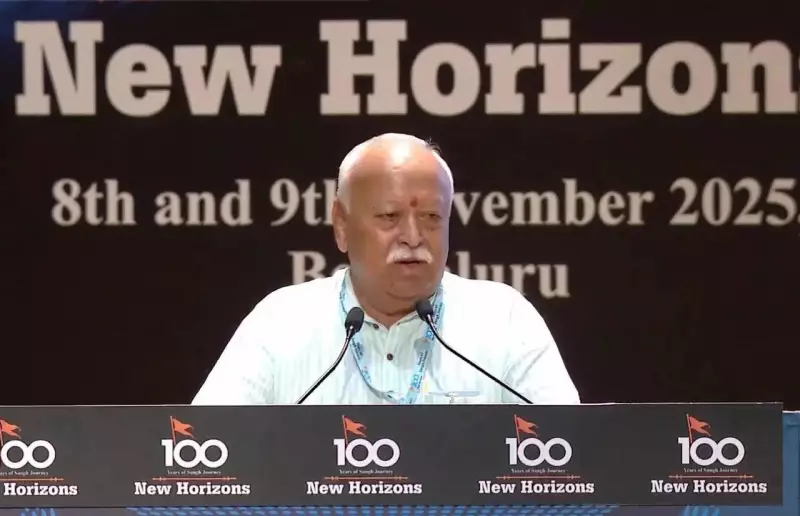
Rashtriya Swayamsevak Sangh (RSS) chief Mohan Bhagwat delivered a significant address in Bengaluru on Saturday, positioning the organization as an organized force that does not seek political power while asserting that Hindus bear responsibility for the nation of Bharat.
Defining RSS Mission and Hindu Responsibility
Speaking at a lecture titled "100 Years of Sangh Journey: New Horizons," Bhagwat emphasized that the RSS focuses on service rather than political ambition. "When an organized force like the Sangh is raised, it doesn't seek power or prominence," he stated, according to PTI reports. "It only wishes to serve and organize society for the glory of Bharat Mata."
The RSS leader noted that while people previously doubted this mission statement, they now recognize its authenticity. He specifically addressed why the organization concentrates on Hindu society, explaining that "Hindus are responsible for Bharat."

Hindu Rashtra Concept and Constitutional Alignment
Bhagwat elaborated on his vision of India as a Hindu Rashtra, clarifying that this concept doesn't contradict the Constitution but rather aligns with it. "The Sangh's goal is to unite the Hindu society. That is why Bharat is a Hindu Rashtra," he asserted during his Bengaluru address.
He challenged the colonial perspective of Indian nationhood, stating that "It's not that the British gave us nationhood; we are an ancient nation." According to Bhagwat, every nation possesses a core culture, and for India, that foundational culture is Hindu.
Inclusive Vision and Centenary Goals
The RSS chief presented an inclusive perspective, noting that Muslims and Christians in India are also "descendants of the same ancestors." He suggested they might be unaware of this heritage or were made to forget it. "Knowingly or unknowingly, everyone follows Bharateeya culture — so nobody is Ahindu (non-Hindu)," he observed.
As the RSS marks its centenary year after being founded in September 1925, Bhagwat reflected on the organization's challenging journey. He recalled decades of opposition, including multiple bans, criticisms, and even murders of swayamsevaks (volunteers). Despite these obstacles, he emphasized that members dedicated themselves to the Sangh without expecting returns, building credibility through sacrifice.
Looking forward, Bhagwat outlined the RSS's ambition to reach every village and social group across India's diverse castes and communities. "We see Hindu society as one, but the world sees diversity. We must reach every section," he noted, adding that the organization aims to organize all 142 crore people of Hindu society across different religious streams.
The RSS has initiated dialogues with those who don't identify as Hindus, signaling an expanded outreach approach as the organization enters its second century of existence.