

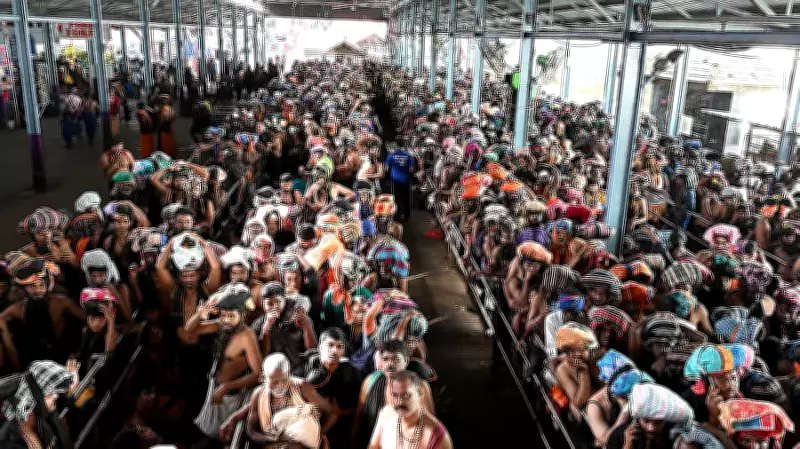
Sabarimala Women's Entry Debate Reignites Ahead of Supreme Court Hearing
The contentious issue of women's entry into the Sabarimala temple has been rekindled in Kerala, sparking intense political debates as the Supreme Court prepares to hear review petitions related to its landmark 2018 verdict. This development comes just ahead of a crucial hearing scheduled for Monday, where the court will consider both review and writ petitions challenging the earlier decision that permitted women of all ages to enter the Lord Ayyappa shrine.
Political Clashes Intensify in Poll-Bound Kerala
The renewed focus on Sabarimala has triggered a fresh war of words between leaders of the ruling Communist Party of India (Marxist) and the opposition Congress party in Kerala, a state that is currently in election mode. Both political factions are leveraging the issue to gain electoral advantage, with the opposition specifically demanding clarity from the state government regarding its stance on implementing the Supreme Court's verdict.
The timing is particularly sensitive as Kerala approaches important electoral contests, making the Sabarimala issue a potent political weapon. The Congress has accused the CPI(M)-led government of "failing to provide clear direction" on whether it will enforce the court's order allowing women's entry, while the ruling party has countered by emphasizing its commitment to constitutional principles and judicial decisions.

Supreme Court's Monday Hearing Looms Large
According to reports, the Supreme Court is scheduled to consider the review petitions on Monday, February 16, 2026. These petitions seek to revisit the court's September 2018 judgment that declared the traditional ban on women aged 10 to 50 from entering Sabarimala as unconstitutional, thereby allowing women of all age groups to worship at the temple.
The 2018 verdict had sparked widespread protests and political turmoil across Kerala, with traditionalists arguing that the ban is an essential part of the temple's centuries-old customs. Since then, the implementation has been inconsistent, with few women successfully entering the temple amid strong resistance from devotees and conservative groups.
Broader Implications for Religious Freedom and Gender Equality
This case represents a significant intersection of religious traditions, constitutional rights, and gender equality in India. The Supreme Court's upcoming hearing could potentially set important precedents for how courts balance religious customs with fundamental rights guaranteed by the Constitution.
Legal experts suggest that Monday's proceedings might address several key questions:
- Whether the 2018 verdict should be reviewed in light of subsequent legal arguments
- How to reconcile religious practices with constitutional guarantees of equality
- The extent to which courts can intervene in matters of religious tradition
- The practical implementation challenges of the original verdict
As Kerala braces for another round of political and social debates surrounding Sabarimala, all eyes will be on the Supreme Court's deliberations next week. The outcome could have far-reaching consequences not just for this particular temple, but for similar disputes across India where religious traditions conflict with modern interpretations of constitutional rights.






