

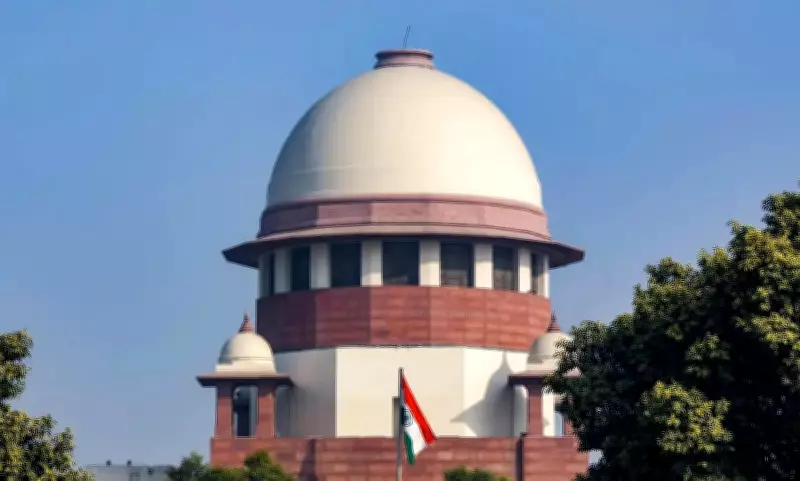
Supreme Court Permits Restored Voters to Participate in Bengal Assembly Elections
In a significant ruling, the Supreme Court of India has acceded to requests from the Trinamool Congress (TMC) and allowed individuals whose names were deleted during the special intensive revision but subsequently restored by appellate tribunals to vote in the upcoming two-phase Bengal assembly polls scheduled for April 23 and 29. This decision comes after persistent appeals from TMC MP and senior advocate Kalyan Banerjee, who urged the court to ensure voting rights for those whose appeals against deletions have been favorably decided.
Court's Directive Under Article 142
A bench comprising Chief Justice of India Surya Kant and Justice Joymalya Bagchi exercised its extraordinary powers under Article 142 of the Constitution to issue this directive. The bench explicitly stated, "If an appeal is allowed by an appellate tribunal and a conclusive direction for inclusion or exclusion is issued, such directions shall be duly effectuated prior to polling on April 23 or 29." This order mandates the Election Commission to implement tribunal decisions promptly, ensuring that restored voters can exercise their franchise without hindrance.
Conditions for Voting Eligibility
The Supreme Court further clarified that appellate tribunals must decide appeals by specific deadlines: April 21 for constituencies voting on April 23, and April 27 for those voting on April 29. Upon such decisions, the Election Commission is required to issue a supplementary revised electoral roll and facilitate all necessary steps to uphold the right to vote. However, the bench firmly rejected arguments from senior advocate Rauf Rahim, who sought voting rights for individuals whose names were included in the 2002 electoral rolls but deleted during the special intensive revision, merely based on pending appeals.

Emphasizing this point, the court declared, "Mere pendency of appeals preferred by excluded persons before the appellate tribunals shall not entitle them to exercise their right to vote." By extension, this logic also applies to individuals included in the voter list but facing pending appeals against their inclusion, who will similarly be barred from voting. This ruling aims to prevent electoral irregularities and ensure that only duly verified voters participate in the democratic process.
Background and Scale of Appeals
The context of this decision involves a massive exercise in voter list scrutiny. Approximately 34 lakh appeals are currently pending before 19 tribunals, highlighting the scale of the issue. To address this, the CJI-led bench, with regular inputs from the Calcutta High Court Chief Justice, deployed around 700 judicial officers—500 from Bengal and 200 from Jharkhand and Odisha. These officers were tasked with scrutinizing claims from about 60 lakh people who sought inclusion after being deleted during the Election Commission's special intensive revision drive.
Most deletions occurred due to 'logical discrepancies,' primarily stemming from individuals' inability to prove their credentials as citizens or their lineage to residents of Bengal. This has raised concerns about voter disenfranchisement and the integrity of the electoral rolls, making the Supreme Court's intervention crucial for maintaining fairness in the upcoming polls.
Related Investigations and Future Hearings
In a related development, the Supreme Court has taken suo motu cognizance of violent attacks on judicial officers engaged in the special intensive revision work in Malda district's Kalichak area. The court has directed the National Investigation Agency (NIA) to investigate these incidents thoroughly. On April 13, the court asked the NIA to disclose the political affiliations of the arrested accused and scheduled a further hearing for April 24, which falls a day after the first phase of polling.
This move underscores the court's commitment to ensuring a secure and transparent electoral environment, free from intimidation and violence. As Bengal prepares for its assembly elections, these rulings and investigations are poised to shape the political landscape, emphasizing the judiciary's role in upholding democratic principles and voter rights.






