

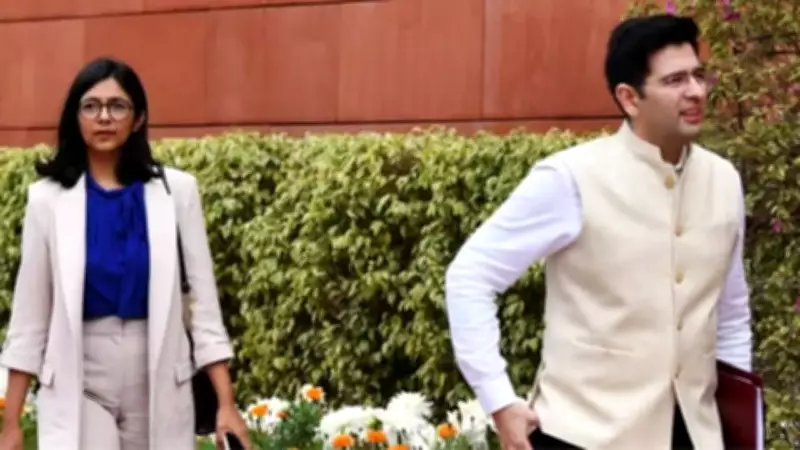
The mass resignation of seven Aam Aadmi Party (AAP) Rajya Sabha members on Friday marks a significant widening of the internal faultline that first emerged in 2024, when Swati Maliwal—one of the seven who resigned—alleged a physical assault at the residence of former Delhi chief minister Arvind Kejriwal.
On May 13, 2024, Swati Maliwal accused a close aide of Arvind Kejriwal of assaulting her at the chief minister's residence. The rift widened further earlier this month when the AAP removed Raghav Chadha from the post of deputy leader in the Rajya Sabha, signaling a deepening internal divide within the party.
Even before their exit on Friday, there were widespread murmurs that their association with the party might not last long. Their colleagues in the party and in the Rajya Sabha—Ashok Mittal, Harbhajan Singh, Rajinder Gupta, Vikram Sahney, and Sandeep Pathak—rarely expressed dissent publicly, which is why their resignation came as a surprise. Earlier in the day, during a press conference, Chadha announced that the seven were exiting the party.

ED Raids and Allegations of Operation Lotus
Ashok Mittal's decision to quit the AAP came close on the heels of Enforcement Directorate (ED) raids at his residential and business premises in Punjab in connection with a Foreign Exchange Management Act (FEMA) case. AAP leader Sanjay Singh blamed the mass desertion on the Bharatiya Janata Party's (BJP) “Operation Lotus.” In a press conference held soon after the exodus, Singh alleged that the seven MPs had quit the party out of fear of action by the ED and the Central Bureau of Investigation (CBI).
Raghav Chadha's Falling Out
Raghav Chadha, a prominent face in the AAP, had reportedly fallen out of favor with the senior leadership after the arrest of the party’s national convener Arvind Kejriwal in 2024. After Swati Maliwal, he was the second AAP Rajya Sabha MP whose differences with the top leadership became public. Chadha was questioned within the party over his absence when Kejriwal was arrested in connection with an excise policy case in March 2024. His silence on key political issues, absence from party events, and lack of participation in raising questions against the Centre in the Upper House also came under scrutiny.
Once considered the “blue-eyed boy” of the AAP leadership, Chadha rose quickly through the ranks and was nominated as a Rajya Sabha MP from Punjab in 2022. Following the party’s victory in the Punjab Assembly elections that year, his influence grew significantly, with him being seen as one of the most powerful leaders in the state after Chief Minister Bhagwant Mann. However, his political standing reportedly declined just as sharply. He was subsequently removed from several key responsibilities, including co-incharge of Punjab affairs and his role as a poll strategist. The AAP's top leaders accused him of distancing himself from the party after the Kejriwal-led Delhi government got embroiled in the excise policy case. He was accused of alienating the party when it hit a rough patch, as one after the other, Kejriwal, his former deputy Manish Sisodia, and Rajya Sabha MP Sanjay Singh were arrested in the case.
The flashpoint came when the party removed Raghav Chadha from the post of AAP deputy leader in the Lok Sabha earlier this month. At the time of his removal, Chadha had warned that he was like a river that would one day turn into a devastating flood when the time was right. His remarks later appeared prescient, as his exit is now seen as having dealt a significant setback to the AAP at a crucial time, with Assembly elections approaching in Punjab, Gujarat, and Goa.
Swati Maliwal's Allegations
Meanwhile, Maliwal, in a long post, alleged that she was leaving the AAP in view of "unchecked corruption" in the party, incidents of "harassment and assault" against women, and promotion of "thuggish" elements under the patronage of Kejriwal. Except for Swati Maliwal, the Rajya Sabha MP from Delhi, all the others who resigned had been elected to the Upper House from Punjab.
The exodus has raised questions about the party's stability and its ability to retain key leaders, especially with crucial state elections on the horizon.






