

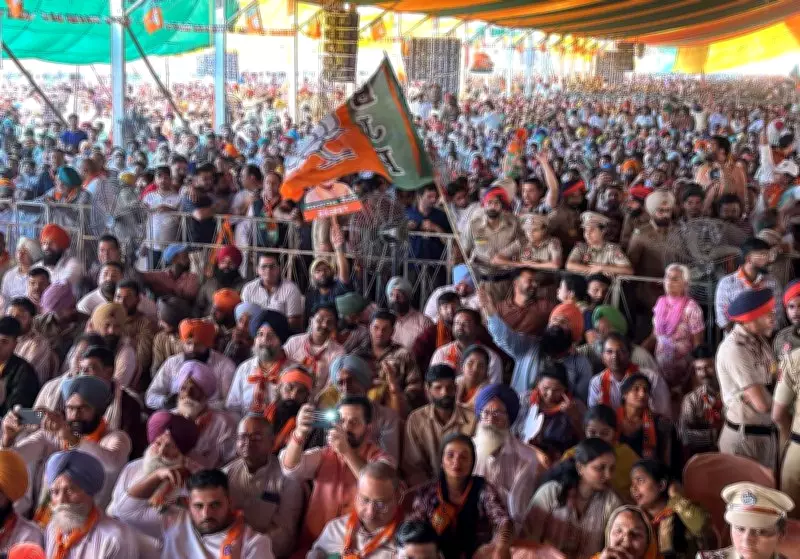
Amit Shah's Moga Rally: A Strategic Outreach to Sikh Community
Union Home Minister Amit Shah made a significant appearance at a Bharatiya Janata Party (BJP) rally in Killi Chahlan village, Moga, on Saturday, delivering a speech rich with symbolism and political messaging aimed at wooing Sikh voters in Punjab. Dressed in a saffron turban, Shah began his address with traditional Sikh greetings, Jo Bole So Nihal, Sat Sri Akal and Waheguru Ji Ka Khalsa, Waheguru Ji Ki Fateh, setting a respectful tone for the event attended by a predominantly Sikh audience.
Crediting Sikh Gurus for Hindu Survival
In a notable statement, Shah asserted that Hindus have survived as a community primarily due to the supreme sacrifices made by the Sikh Gurus. This remark is particularly striking coming from a senior leader of the BJP, a party often associated with Hindutva ideology and aspirations for a Hindu Rashtra. Shah elaborated on his choice of attire, explaining that the saffron turban symbolized his indebtedness to Guru Tegh Bahadur, who sacrificed his life to protect Kashmiri Pandits and Hindus from forced conversions under Mughal emperor Aurangzeb.
Embracing Sikh Distinctiveness: A Shift in Stance
Equally significant was Shah's decision to congratulate the gathering on the Nanakshahi New Year, the Sikh calendar that the BJP had historically opposed. Previously, the party's objections led to its withdrawal when the Shiromani Akali Dal (SAD), a former alliance partner, advocated for it. The Nanakshahi calendar, which marks Sikh festivals independently of the Hindu Vikrami calendar, has been a point of contention. Historian and author Jagtar Singh noted that Shah's acknowledgment represents a significant departure from the BJP's earlier position, suggesting a studied gesture to accept Sikh distinctiveness and potentially mend ties with the community.

Broadening Appeal: Dalits and Freedom Fighters
Shah's speech extended beyond Sikh symbolism to include broader outreach efforts. He invoked the legacies of Guru Ravidas and Bhagwan Balmiki, targeting Dalit voters whose support is crucial in Punjab's political landscape. Emphasizing Hindu-Sikh unity, Shah framed it not as an assertion of sameness but as a partnership between distinct communities, highlighting mutual respect and cooperation.
Additionally, Shah paid tributes to freedom fighters Bhagat Singh, Rajguru, and Sukhdev, connecting with Punjab's historical pride. On the political front, he declared that the BJP would contest the upcoming state elections alone, signaling a strategic shift in the party's approach in Punjab amid changing alliances.
Analysis: BJP's Evolving Strategy in Punjab
This rally underscores the BJP's efforts to recalibrate its strategy in Punjab, a state with a significant Sikh population. By honoring Sikh traditions and acknowledging historical sacrifices, Shah aims to build bridges with a community that has often been at odds with the party's Hindutva agenda. The move to accept the Nanakshahi calendar and emphasize distinctiveness may help the BJP appeal to moderate Sikh voters while maintaining its core Hindu base.
As the state polls approach, such gestures could play a pivotal role in shaping voter perceptions and alliances. However, it remains to be seen how this outreach will translate into electoral gains, given the complex socio-political dynamics in Punjab.






