

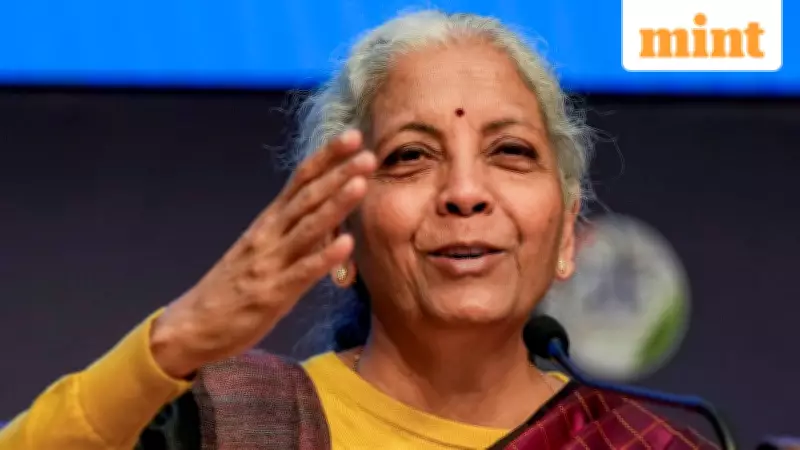
Finance Minister Nirmala Sitharaman has delivered a sharp rebuttal to Congress leader Rahul Gandhi's criticism of the Union Budget 2026, specifically targeting his remarks about 'youth without jobs.' In a firm response, she has called upon Gandhi to substantiate his claims with concrete facts while defending the budget as comprehensive and inclusive.
Budget Presentation and Immediate Reactions
On Sunday, February 2026, Nirmala Sitharaman presented the Union Budget in Parliament, outlining the government's fiscal plans for the upcoming year. Shortly after, Rahul Gandhi took to social media platform X to voice his disapproval, posting a message that highlighted several economic concerns.
His post read: "Youth without jobs. Falling manufacturing. Investors pulling out capital. Household savings plummeting. Farmers in distress. Looming global shocks - all ignored. A Budget that refuses course correction, blind to India’s real crises."

Sitharaman's Defense of Economic Fundamentals
Addressing the media in a customary post-Budget interaction, Sitharaman directly countered these assertions. "With due respect, I don't know what course correction he (Gandhi) is referring to," she stated emphatically. "Economy and its fundamentals are strong. Global uncertainty is facing many of our sectors for whom we have brought in so many different schemes for those small and medium enterprises, textiles, leather...for farmers and women entrepreneurs."
She further elaborated that the government is actively reaching out to common people, particularly those in rural and difficult terrains, to ensure they benefit from various schemes. This outreach, she argued, demonstrates the budget's focus on all sections of society.
Initiatives for Women Entrepreneurs and Economic Support
In her budget speech and subsequent comments, Sitharaman highlighted specific measures aimed at bolstering economic growth and supporting vulnerable groups. One key announcement was the proposal to establish Self-Help Entrepreneur (SHE) Marts.
"Building on the success of the Lakhpati Didi Programme, I propose to help women take the next step from credit-led livelihoods to being owners of enterprises," she explained. "Self-Help Entrepreneur (SHE) Marts will be set up as community-owned retail outlets within the cluster level federations through enhanced and innovative financing instruments."
This initiative is designed to empower women by transitioning them from mere beneficiaries of credit to actual business owners, thereby addressing economic participation and job creation at the grassroots level.
Call for Fact-Based Criticism
Sitharaman did not shy away from inviting political scrutiny but insisted it be grounded in verifiable data. "The fundamentals of the economy remain strong and that has come out even in the economic survey," she noted. "So, well, politically you want to criticize...You are welcome, please do it. But if you want to give me the facts on which you're basing your argument, I'm willing to hear and willing to reply to that."
This statement underscores her stance that while criticism is acceptable in a democracy, it must be backed by evidence rather than rhetoric. She emphasized that the budget has been crafted to navigate global uncertainties while supporting key sectors like SMEs, textiles, leather, and agriculture.
Broader Economic Context and Government Outreach
The finance minister reiterated that the government's approach is holistic, aiming to mitigate the impacts of global shocks on domestic industries. By introducing tailored schemes for small and medium enterprises, as well as for farmers and women entrepreneurs, the budget seeks to foster resilience and growth across diverse economic segments.
Sitharaman's remarks also touched on the importance of ensuring that policy benefits reach the most marginalized, reinforcing the budget's theme of inclusivity. She asserted that contrary to Gandhi's claims, the budget does not ignore real crises but actively addresses them through strategic interventions.

As the political discourse around Budget 2026 intensifies, this exchange highlights the ongoing debate over India's economic direction and the effectiveness of government policies in tackling issues like unemployment and sectoral distress.





