

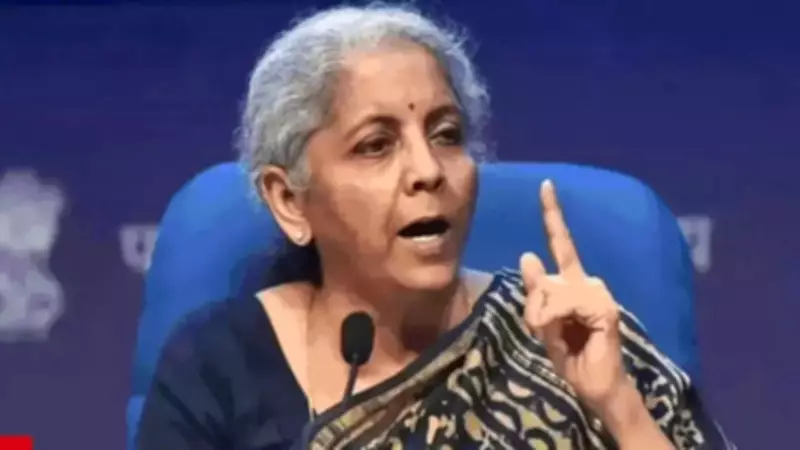
Finance Minister Nirmala Sitharaman Defends Cesses and Surcharges in Lok Sabha
Finance Minister Nirmala Sitharaman on Wednesday delivered a robust defense of the central government's use of cesses and surcharges, firmly rejecting criticism from various states. Speaking during the discussion on the Budget in the Lok Sabha, she argued that these levies are entirely in line with Constitutional provisions and that the funds collected are ultimately spent on schemes that benefit the states directly.
Clarifying the Divisible Pool and State Shares
Sitharaman emphasized a crucial distinction that states must understand: the difference between gross tax revenue and the net proceeds that are legally shareable. "States cannot have it both ways," she stated categorically. "The states should meticulously check if they are receiving the entire net proceeds which form the divisible pool, after the legitimate removal of cess and surcharge from the gross tax revenue."
She provided detailed data to support her position, noting that the Centre is transferring exactly 41% of the divisible pool to the states, as mandated by the Finance Commission's recommendations. "The 16th Finance Commission conducted a thorough analysis of the state's share transferred by the Centre from 2018-19 to 2022-23," Sitharaman explained. "Their conclusion was unequivocal: in each of these years, the devolution made by the Centre precisely matched the Finance Commission's recommendation. This is not merely our claim; it is an independent verification, leaving no scope for doubt among the states."

Accusations of State-Level Hypocrisy on Taxation
The Finance Minister launched a pointed critique against certain state governments, specifically targeting West Bengal where Mamata Banerjee's Trinamool Congress (TMC) is in power. She accused them of contradictory behavior regarding the Goods and Services Tax (GST).
"While these state governments vocally blame the Centre for the GST burden on citizens, they simultaneously impose additional financial burdens at the state level," Sitharaman argued. She cited the example of West Bengal imposing road levies and charging taxes during new vehicle registration. "If there is genuine concern about GST burdening the people, why not waive these state-level taxes? Instead, we see a pattern where GST collections are criticized, yet state taxes continue unabated."
She directly accused TMC leader Abhishek Banerjee of "twisting facts on GST" to mislead the public, highlighting what she described as a disconnect between political rhetoric and administrative action.
Countering Opposition Claims on Data and Economic Policy
In a broader rebuttal to opposition leaders, Sitharaman addressed concerns raised by Congress leader Rahul Gandhi. She outlined the government's proactive measures to incentivize data centers within the country, countering claims about Indian data security and infrastructure.
Furthermore, she listed a series of government initiatives:
- Reforms and support for Special Economic Zones (SEZs)
- Comprehensive customs reforms to ease trade
- Targeted support programs for Micro, Small, and Medium Enterprises (MSMEs)
These measures, she asserted, directly address the economic challenges highlighted by the opposition. "The Leader of the Opposition expressed concerns over geopolitics, energy security, and the weaponization of finance," Sitharaman noted. "He acknowledged that the Budget recognizes these challenges, but perhaps he did not fully read the detailed steps announced within it to systematically address each one."
The Finance Minister's comprehensive response underscored the government's stance on fiscal federalism, defending its taxation strategy while challenging states on policy consistency and implementation.






