

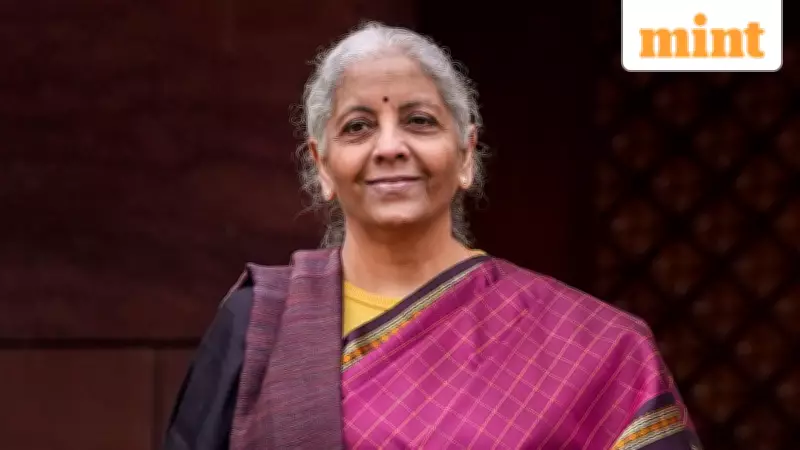
Shiv Sena UBT MP Priyanka Chaturvedi's forecast regarding Finance Minister Nirmala Sitharaman's Budget Day attire has seemingly materialized, though not in the realm of fiscal policy. Instead, Chaturvedi's anticipation centered on the symbolic significance of Sitharaman's saree selection, which unfolded as she presented her ninth consecutive Budget in Parliament today, setting a historic record for any Indian Finance Minister.
The Saree That Sparked Political Interpretation
For Budget 2026, Finance Minister Nirmala Sitharaman adorned a traditional Kanjeevaram silk saree, also recognized as a Kanchipuram saree, meticulously crafted in Tamil Nadu. These exquisite garments are renowned for their luxurious texture, woven from pure mulberry silk, and distinguished by their broad, contrasting borders. While Sitharaman has consistently utilized her Budget Day attire to celebrate India's diverse handloom heritage, Priyanka Chaturvedi perceives a deeper political narrative woven into this year's choice.
Chaturvedi's Prescient Commentary
On January 31, Priyanka Chaturvedi articulated her expectations to ANI, stating, "I hope the Finance Minister presents the nation's Budget and not election-going state Budget, where we see her present the Budget, wearing Tamil Nadu handloom weave, speaking parts of speech in Bengali, with a policy announcement for tea gardens of Assam." This remark, now viewed as a prediction, directly alludes to what Chaturvedi interprets as Sitharaman's subtle political messaging ahead of impending state elections.

Following the Budget presentation, Chaturvedi promptly took to social media to assert that the Finance Minister indeed wore a "Tamil Nadu Handloom weave," captioning her post with "As predicted." This exchange underscores the growing scrutiny of sartorial choices in political contexts.
Electoral Landscape and Timing
The Election Commission of India has not yet released the official schedule for the 2026 Tamil Nadu Legislative Assembly elections. However, political analysts anticipate the polls to occur between April and May. The current 16th Tamil Nadu Legislative Assembly, under the leadership of Chief Minister MK Stalin, is constitutionally mandated to conclude its term on May 10, 2026. Typically, the ECI announces comprehensive election timelines, including notification, nomination, and polling dates, approximately one to two months prior to the elections.
Additionally, Assam and West Bengal are poised for electoral contests this year. West Bengal's elections are projected for March–April, with the 17th West Bengal Legislative Assembly's term, led by Chief Minister Mamata Banerjee, expiring on May 7. Similarly, Assam is expected to hold elections in March–April, as the 15th Assam Legislative Assembly, under Chief Minister Himanta Biswa Sarma, approaches the end of its tenure on May 20.
Sitharaman's Established Saree Tradition
Over the past three years, Finance Minister Nirmala Sitharaman has cultivated a pattern of selecting Budget Day sarees that correspond with upcoming state elections, blending cultural appreciation with political nuance.
- 2023: Sitharaman chose a vibrant red Ilkal silk saree featuring intricate Kasuti embroidery, widely interpreted as a nod to the Karnataka elections held later that year.
- 2024: She highlighted two states through her attire. For the Interim Budget, she wore a blue Tussar silk saree adorned with traditional Kantha work from Bengal, preceding the Lok Sabha elections. For the full Budget, she selected an off-white Mangalgiri saree from Andhra Pradesh, coinciding with significant financial announcements for the state following the NDA's electoral success.
- 2025: Sitharaman donned an off-white Madhubani hand-painted silk saree from Bihar, gifted by Padma Shri artist Dulari Devi. This choice garnered attention as Bihar geared up for its Assembly elections later that year.
This recurring practice underscores how sartorial decisions in high-profile political settings can transcend mere fashion, becoming instruments of cultural diplomacy and electoral signaling. The debate ignited by Chaturvedi's comments reflects the intricate interplay between tradition, politics, and public perception in India's democratic fabric.






