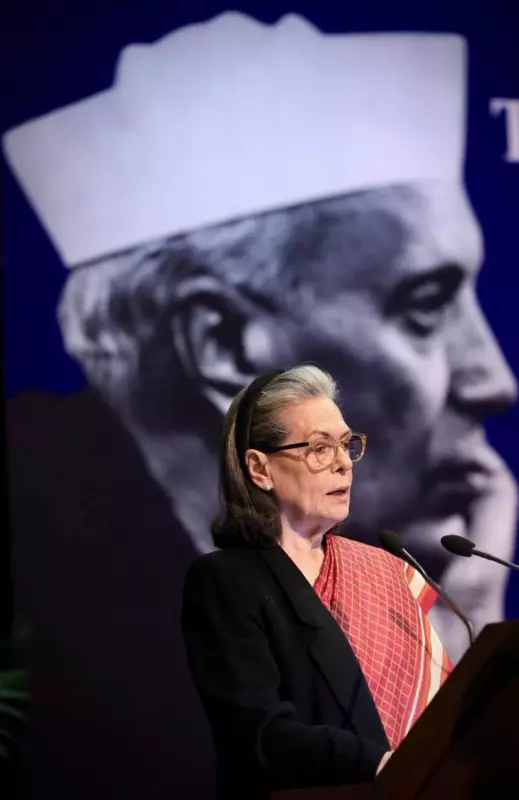
In a powerful and rare address, Congress Parliamentary Party chairperson Sonia Gandhi launched a sharp critique against the ruling Bharatiya Janata Party (BJP). She accused the party of orchestrating a sustained and deliberate campaign to vilify the legacy of India's first Prime Minister, Jawaharlal Nehru.
A Forceful Defence of Nehru's Contributions
Sonia Gandhi's speech served as a robust defence of Nehruvian ideals. She emphasized that Jawaharlal Nehru laid the foundational stones of modern, democratic, and secular India. According to her, his vision and policies were instrumental in building the nation's key institutions, fostering scientific temper, and establishing a pluralistic society in the tumultuous years following independence.
She argued that the current political discourse, driven by the BJP, is attempting to rewrite history. Gandhi stated there is a 'systematic attempt' being made to distort historical facts and defame Nehru's immense contributions. This effort, she implied, is not merely political criticism but a targeted endeavour to diminish the core values upon which the Republic of India was built.

The Political Context and Accusations
The speech comes amid an ongoing political tussle where figures from the BJP have frequently criticized Nehru's policies, holding him responsible for various contemporary issues. From the Kashmir problem to economic challenges, Nehru's tenure has been a focal point for the ruling party's historical critique.
Sonia Gandhi countered these narratives head-on. She highlighted that the institutions and the democratic framework we cherish today are a direct result of Nehru's foresight. She portrayed the attacks as an attack on the idea of India itself, suggesting that undermining Nehru is a strategy to sideline the constitutional ethos of inclusivity and secularism.
Her address was not just a historical rebuttal but a clear political message aimed at rallying the Congress party and its allies. It positioned the Congress as the guardian of a legacy that is under threat, seeking to draw a stark ideological line between the two major political formations in the country.
Implications and the Road Ahead
This direct confrontation from a senior Congress leader is significant. It signals a more aggressive stance from the opposition in defending its history and countering the BJP's narrative control. The 'vilification' of Nehru has become a central flashpoint in India's ongoing culture wars.
The speech is likely to intensify the war of words between the Congress and the BJP, especially in the lead-up to future elections. It frames the political battle as one between two contrasting visions of India's past and future. For the Congress, anchoring itself to the Nehru-Gandhi legacy remains a core strategy, while the BJP continues to promote its own pantheon of historical icons and narratives.
Ultimately, Sonia Gandhi's rare intervention underscores the deep ideological divisions in Indian politics. The debate over history is not academic but intensely political, with each side seeking to claim the mantle of the nation's true inheritors and future architects. The systematic attempt to defame Nehru, as alleged by Gandhi, is set to remain a contentious and defining feature of India's political discourse for the foreseeable future.