

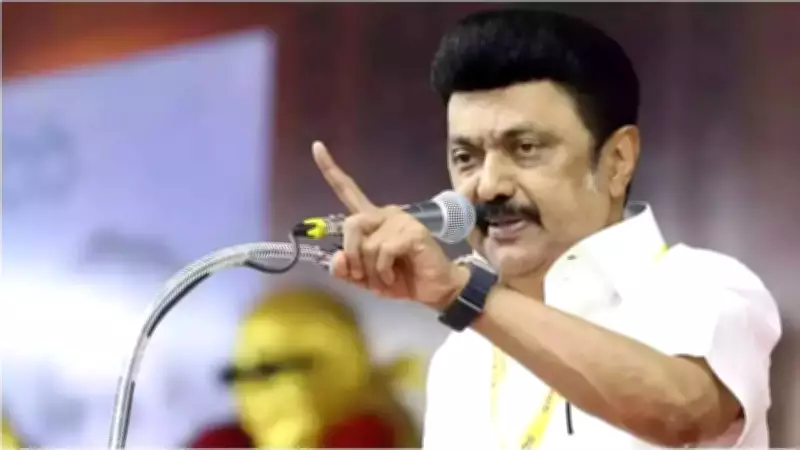
Tamil Nadu Chief Minister M K Stalin Urges Caution on Delimitation Bills
In a significant intervention, Tamil Nadu Chief Minister M K Stalin has emphasized that delimitation is not a mere mechanical arithmetic exercise. He argues it must carefully balance the equality of citizens with the dignity of states, preserving the delicate federal equilibrium of India's diverse Union. Stalin stresses that this moment demands thorough deliberation, not undue haste, quoting Alexander Hamilton from The Federalist No. 70: "In the legislature, promptitude of decision is oftener an evil than a benefit."
Constitutional Amendments Require Restraint and Sobriety
Stalin highlights that a Constitution is an enduring charter of a people, and its amendment should be approached with restraint, sobriety, and deep deliberation. He asserts that while haste is undesirable in ordinary legislation, it is wholly inappropriate when altering constitutional fundamentals. Measures grounded in sound policy welcome scrutiny, whereas those driven by narrow, self-serving objectives often seek refuge in speed. True statesmanship, he notes, invites scrutiny rather than evading it.
A stark example is the proposed consideration of the One Hundred and Thirty-first Constitution Amendment Bill, 2026, the Delimitation Bill, 2026, and the Union Territories Laws Amendment Bill, 2026. These are slated for a special Parliamentary session from April 16 to 18, barely a fortnight after the Budget Session concluded on April 2, with bills circulated to MPs just two days in advance. Stalin warns these bills raise serious concerns for democratic legitimacy and India's federal balance.

The Architecture of Representation and Its Implications
Delimitation is a consequential constitutional process that determines how citizens are represented in the Lok Sabha and state legislative assemblies, shaping political power distribution. Once completed, its outcomes are virtually immune from challenge, which Stalin identifies as a critical issue. The Constitution envisages delimitation as a periodic, post-Census exercise, with Articles 81 and 82 prescribing a two-stage process for the Lok Sabha: first, allocating seats among states to maintain proportionality, and second, dividing each state into roughly equal population constituencies.
Article 170 applies similar logic to state assemblies. In the R C Poudyal vs Union of India case (1993), the Supreme Court affirmed proportionality as a guiding principle, not a mathematical straitjacket, allowing deviations to preserve federal balance. Parliament enacts a Delimitation Act after each Census, entrusting the exercise to an independent commission appointed by the Union government.
The Great Freeze and Demographic Disparities
The total fertility rate (TFR) serves as a clear index of demographic change, with 2.1 regarded as replacement level. According to sample registration system data, India's TFR was 5.2 in 1971, ranging from 6.1 in Uttar Pradesh to 3.9 in Tamil Nadu. By 2001, it declined to 3.1, but disparities persisted, from 4.5 in Uttar Pradesh to 1.8 in Kerala. Demographic transitions were uneven across states, with some achieving early fertility decline through investments in education and public health, while others lagged.
Stalin points out that strict population-based redistribution would penalize successful states and reward inaction. This concern is compounded by the Rajya Sabha's design, which, though conceived as a council of states, has a population-based composition, making it a near-replica of the Lok Sabha. Unlike federations like the United States or Australia, which balance citizen equality in the Lower House with state equality in the Upper House, India's model leaves smaller states vulnerable.
An alternative is degressive proportionality, where smaller units get minimum seats and larger ones face ceilings, as seen in the European Parliament or Brazil. In the absence of such safeguards, the Forty-second Constitutional Amendment of 1976 froze inter-state Lok Sabha seat allocation at 1971 Census levels for 25 years, extended by the Eighty-fourth Amendment in 2001 until the first Census after 2026. These acts were considered constitutional statesmanship to preserve federal equilibrium.

Continuing Validity of the Freeze and Regional Disparities
In 1971, Tamil Nadu and present-day Bihar had comparable populations and Lok Sabha representation. By 2025 estimates, Bihar's population has risen significantly, potentially increasing its seats while Tamil Nadu's would decline. A similar divergence exists between Rajasthan and Andhra Pradesh. Stalin argues that rewarding states with higher fertility rates while penalizing those with lower rates is akin to demoting successful employees and promoting underperformers.
According to 2023 SRS data, India's TFR has declined to 1.9, but regional disparities persist. Hindi heartland states like Bihar and Uttar Pradesh have higher rates, while states like Kerala, Tamil Nadu, and Maharashtra have achieved lower levels. Stalin concludes that despite nationwide decline, demographic convergence is lacking, and the freeze should be extended until 2051 or until convergence is achieved.
Perils of the Proposed Framework and Legislative Scrutiny
The 131st Constitution Amendment Bill seeks to redefine "population" and delink delimitation from the latest Census, potentially using 2011 data instead. Stalin deems this constitutionally incongruous and normatively indefensible. The proposal to increase Lok Sabha strength from 550 to 850 seats, while ensuring no state loses existing representation, would alter relative weights, disadvantaging states like Kerala and Tamil Nadu.
Stalin advocates for preserving each state's percentage share in an enlarged House, noting oral assurances from Union ministers but highlighting the absence of such provisions in the bill. He also warns against expanding the Lok Sabha, citing global examples like the US House remaining at 435 since 1929, and argues it would erode debate and committee effectiveness.
Furthermore, the bill links women's reservation to delimitation, which Stalin calls unnecessary and a smokescreen to mask lifting the freeze. He emphasizes the need for legislative scrutiny and judicial review, citing recommendations from the Justice Kurian Joseph Committee to introduce checks and balances in the delimitation process.
Call for Deliberation and Constitutional Integrity
Stalin urges the Union government to withdraw the bills and introduce fresh legislation after public consultation. He reiterates that delimitation is an act of constitutional statesmanship, requiring reflection and principle-driven amendments to maintain fairness and India's federal integrity.





