

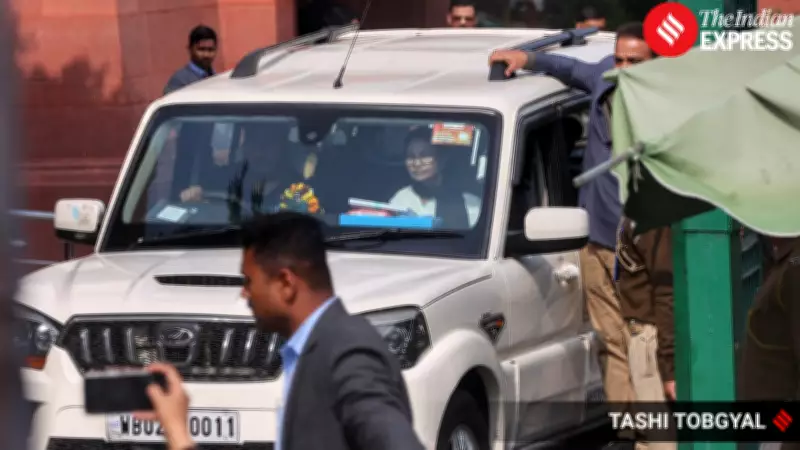
Supreme Court Becomes New Battleground in EC vs Mamata Banerjee Government Clash
By personally appearing in the Supreme Court to argue against the Election Commission's Special Intensive Revision (SIR) exercise in West Bengal, Chief Minister Mamata Banerjee has escalated her war of attrition with the poll panel into unprecedented territory. This move marks the latest chapter in a series of intense disagreements between the state government and the EC, which have been simmering since the initiation of the SIR process.
Infrastructure Overhaul and Polling Booth Controversy
A significant point of contention revolves around the infrastructure revamp of polling booths. Mackintosh Burn, a state-owned engineering and construction PSU, wrote to the West Bengal Chief Electoral Officer in October, seeking exemption from overhauling over 80,000 poll booths ahead of the Assembly elections, citing the absence of a formal agreement. This request drew a sharp rebuke from the CEO, who warned of criminal proceedings if the work was not executed. The stalemate prompted the West Bengal BJP president to approach the Calcutta High Court, which has since directed both the EC and state government to file reports on the matter.
FIRs Against Officials and Electoral Fraud Allegations
Another flashpoint involves the EC's demand for action against officials accused of fraudulent voter registrations. In August last year, the poll panel asked the Trinamool Congress government to suspend and file FIRs against four officials and a contractual employee for allegedly using forged documents to register 127 voters in Baruipur Purba and Moyna constituencies. While the officers were eventually suspended, the state government has resisted filing FIRs, opting instead for departmental proceedings, a move that has further strained relations with the EC.

Transfer of IAS Officers and Poll Observers
The West Bengal government's transfer of three IAS officers appointed as poll observers by the EC between December 2025 and January 2026 has also sparked conflict. The EC ordered the withdrawal of these transfer orders, emphasizing that no official involved in the SIR process should be moved without prior approval. In response, the state government defended its actions, claiming the transfers were to "comparatively unimportant" posts to allow the officers to focus more on the SIR, a justification the EC has not accepted.
FIRs Against MLAs and Vandalism Incidents
The EC has also directed the filing of FIRs against two TMC MLAs, Manirul Islam and Mosaraf Hossain, for alleged vandalism of block offices in Murshidabad and North Dinajpur, respectively. These orders followed incidents linked to tensions over the SIR, with Islam controversially describing the EC's notice as biased. To date, no FIRs have been filed by the district administration, and both the EC and state government have remained largely silent on this issue recently.
Appointment of Central Poll Observers
In a further escalation, the EC named Home Secretary Jagdish Prasad Meena as a Central observer for the upcoming Assembly elections, requiring his attendance at a key meeting. The state government sought exemption for Meena and eight other officers, citing their engagement in important state duties and proposing alternative names. However, the EC rejected this request, insisting on their participation, which has added to the ongoing friction.
Special Officers and Counter-Moves
The TMC government's deputation of "special officers" to oversee developmental processes in 23 areas has been interpreted as a counter to the EC's appointment of roll observers in Bengal. With the EC now deploying 34 observers and around 7,000 micro observers for the SIR, this tit-for-tat strategy underscores the deepening rift between the two entities.
Overall, these multifaceted conflicts highlight the intense power struggle between the Election Commission and the Mamata Banerjee administration, with the Supreme Court becoming the latest arena for this high-stakes confrontation. The outcomes of these disputes could have significant implications for the conduct of elections in West Bengal and the broader dynamics of federal-state relations in India.






