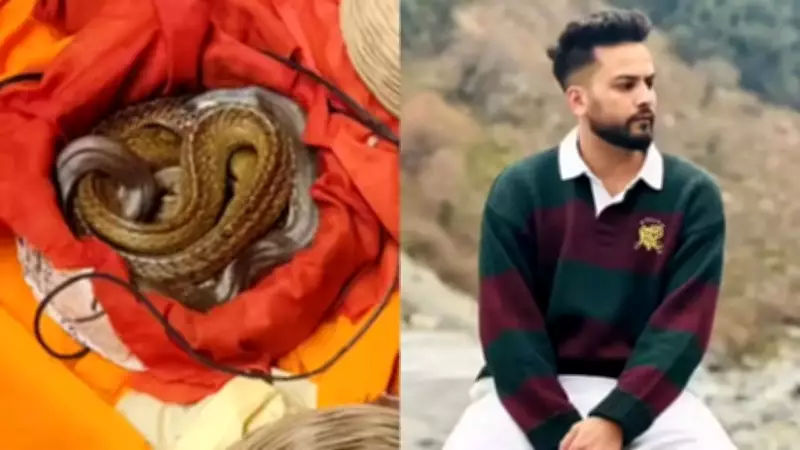
Supreme Court to Scrutinize Wildlife Act Complaint Against YouTuber Elvish Yadav in Snake Venom Case
The Supreme Court of India has signaled potential legal challenges ahead for popular YouTuber Elvish Yadav, as it announced it would examine a complaint against him under the Wildlife (Protection) Act in connection with the snake venom case. The court expressed concern that allowing influential individuals to exploit "voiceless victims" like snakes could set a detrimental precedent for society.
Court Hearing and Key Arguments
During a hearing on Wednesday, a bench comprising Justices M. M. Sundresh and N. Kotiswar Singh addressed a petition filed by Yadav, who is challenging the chargesheet and criminal case initiated against him. The bench posed pointed questions to Yadav's lawyer, senior advocate Mukta Gupta, emphasizing the gravity of the allegations. "If popular persons are allowed to use 'voiceless victims' like snakes, it could send a very bad message to the society," the justices remarked. They further inquired, "You take the snake and play around. Did you deal with the snake or not? Can you go to the zoo and play with animals there? Will it not be an offence? You can't say that you'll do whatever you want. We are concerned with the complaint under the Wildlife (Protection) Act."
Background of the Case
Elvish Yadav, a controversial YouTuber and influencer known for his appearances on television reality shows, was initially charged in November 2023 and later arrested on March 17, 2024. The allegations stem from an incident in Noida, Uttar Pradesh, where snake venom was reportedly used as a recreational drug at a rave party. According to the chargesheet, this activity involved several attendees, including foreigners, raising serious legal and ethical concerns.

Defense and Prosecution Arguments
In defense of Yadav, senior advocate Mukta Gupta argued that he had merely attended the event as a guest appearance in a video by singer Fazilpuria. She contended that there was no concrete evidence of a rave party occurring or of any banned psychotropic substances being consumed. Gupta also stated that Yadav was not present at the alleged location and highlighted medical reports indicating that the nine snakes examined were non-venomous.
Conversely, the state's counsel informed the court that police had recovered nine snakes, including five cobras, and had seized what they believed to be snake venom allegedly used at the rave parties. The Supreme Court directed the state's counsel to provide details on how snake venom is extracted and its purported use in such events, underscoring the need for clarity in the investigation.
Legal Proceedings and Media Impact
The matter has been scheduled for a next hearing on March 19, following earlier developments where the apex court had put a stay on trial court proceedings against Yadav on August 6 last year. Yadav's counsel had previously argued before the high court that no snakes, narcotic drugs, or psychotropic substances were recovered from him, and no direct connection was established between Yadav and the co-accused. Additionally, it was submitted that the informant, who filed the FIR presenting himself as an animal welfare officer, was no longer serving in that capacity.
The case has attracted significant media attention, partly due to Yadav's status as a well-known influencer. His involvement has sparked widespread discussion on wildlife protection laws and the responsibilities of public figures. As the Supreme Court prepares to delve deeper into the complaint, the outcome could have far-reaching implications for enforcement of the Wildlife (Protection) Act and accountability in high-profile cases.