

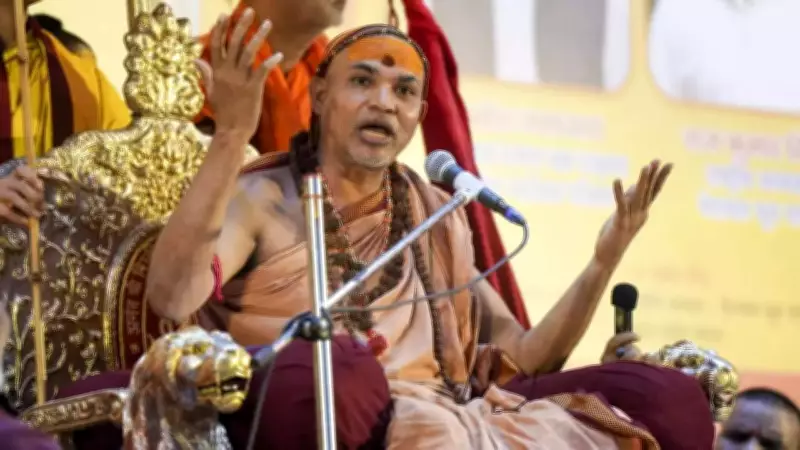
Swami Avimukteshwaranand Controversy: A Perfect Storm of Faith, Law, and Politics
The controversy surrounding Swami Avimukteshwaranand Saraswati from Jyotish Peeth in Uttarakhand's Joshimath vividly captures the complex overlap of faith, law, and politics in India. In recent weeks, the seer has found himself at the center of a political and legal storm that stretches from allegations under the Protection of Children from Sexual Offences (POCSO) Act to a decades-old dispute over who has the right to call himself the Shankaracharya of Jyotirmath.
The Revered Title of Shankaracharya
For many followers of Sanatan Dharma, the position of Shankaracharya is among the most revered spiritual roles in Hindu tradition. Yet today, the legitimacy of Avimukteshwaranand's claim to that title is being questioned in courtrooms, debated in political circles, and argued over within the saint community itself. The controversy has also deepened fault lines in Uttar Pradesh politics, with the ruling establishment appearing divided and opposition parties framing the dispute as an attack on a Hindu religious figure.
Understanding the Institution of Shankaracharya
To grasp the significance of the title Shankaracharya, one must return to the figure who created the institution. Adi Shankaracharya was a philosopher and spiritual reformer who lived in the eighth century. At a time when Hindu traditions were fragmented into numerous sects and ritual practices, Shankaracharya sought to revive a unified philosophical vision. His central teaching was Advaita Vedanta, which holds that the individual soul and the universal reality are ultimately the same.

According to Advaita, the world of differences is a result of ignorance, and true knowledge reveals the unity of existence. To preserve this philosophical tradition, Shankaracharya established four monastic centers across India, each meant to guide spiritual learning in a different region.
The Four Peethas of Shankaracharya
The four traditional Shankaracharya seats are spread across the country:
- Jyotirmath (Jyotish Peeth) in Uttarakhand representing the northern region
- Sringeri Sharada Peeth in Karnataka representing the south
- Govardhan Math in Puri representing the east
- Dwarka Sharada Peeth in Gujarat representing the west
Each peeth is associated with a particular Veda and has its own line of succession. The head of each institution is called a Shankaracharya. Unlike many religious positions, the title is not granted by the state. It is traditionally decided within the monastic order based on scholarship, spiritual discipline, and acceptance among senior monks. Because there is no single central authority governing all four seats, disagreements over succession sometimes occur.
Why Swami Avimukteshwaranand is Making Headlines
The answer appears to lie in three parallel developments: a POCSO case was registered against him; the unresolved dispute over the Jyotirmath Shankaracharya seat; and the institution's long-running succession battles.
The First Layer: Sexual Exploitation Charge
The latest controversy erupted after a special POCSO court in Prayagraj directed the police to register a case against Avimukteshwaranand and his disciple Swami Mukundanand Giri. The complaint alleged that two minor boys were sexually exploited at the seer's camp during the 2025 Magh Mela and Maha Kumbh. Acting on the court's directions, the Jhunsi police registered an FIR invoking multiple sections of the POCSO Act along with provisions of the Bharatiya Nyaya Sanhita (BNS).
The complainant in the case is Ashutosh Brahmachari Maharaj, who is also associated with litigation in the Krishna Janmabhoomi-Shahi Eidgah dispute. Avimukteshwaranand, however, has categorically denied the accusations, calling them fabricated.
Magh Mela Row
Another episode that intensified the controversy took place earlier this year during the Magh Mela in Prayagraj. Magh Mela is an annual Hindu religious gathering held in Prayagraj during the Hindu month of Magh (January–February). Devotees take ritual baths at the sacred confluence called the Triveni Sangam, where the Ganga, Yamuna, and the mythical Saraswati rivers meet.

Avimukteshwaranand claimed he was prevented from taking a holy dip at the Sangam during Mauni Amavasya, which is a sacred Hindu new moon day in the month of Magh when devotees observe maun (silence) and take ritual baths at holy rivers. He alleged that the administration stopped his palanquin procession and insulted his followers. The authorities denied the allegation.
Officials said the issue was not about preventing the ritual bath but about crowd management. During peak bathing days, they said, large processions or vehicles are restricted to prevent stampede-like situations. The dispute escalated into a protest by the seer, who staged a sit-in at the mela site and later left without taking the ritual dip. The episode quickly became political, with opposition leaders accusing the government of disrespecting a Hindu spiritual leader.
According to the seer, the two minor boys mentioned in the sexual exploitation complaint never entered his gurukul and were actually students of a school in Hardoi. Their school records, he claimed, were already submitted in court. He has also said that he will cooperate fully with the investigation and does not fear arrest. In a public statement, he questioned why alleged evidence such as a purported CD has not been made public. He insisted that CCTV cameras around his camp would reveal the truth.
The seer has gone further, accusing certain individuals of trying to malign Hindu institutions from within. Meanwhile, the police have begun a preliminary probe and said that electronic and digital evidence will be examined.
A Dramatic Twist with Attack on Complainant
The controversy took another dramatic turn when the complainant claimed he was attacked on a train while travelling to Prayagraj to submit evidence in court. Ashutosh Brahmachari alleged that an unidentified man tried to assault him with a sharp object and cut his nose, supposedly for a reward allegedly announced by one of the seer's followers.
Police have registered a separate FIR in connection with the incident and said the matter is under investigation. Avimukteshwaranand has again dismissed the claim as suspicious and questioned how such an attack could occur in a train compartment without witnesses.
The Second Layer: Dispute Over the Title
While the POCSO case has brought immediate attention, Avimukteshwaranand's claim to the title of Shankaracharya has been under dispute for years. At the center of the issue is the Jyotirmath or Jyotish Peeth, one of the four monastic seats established centuries ago by the philosopher saint Adi Shankaracharya. These institutions are among the most important spiritual centers in Hinduism.
Avimukteshwaranand declared himself Shankaracharya in 2022 after the death of his guru, Swami Swaroopanand Saraswati. However, his coronation was challenged and the matter reached the Supreme Court. The top court stayed the formal coronation ceremony, citing an earlier order that prohibited appointments to the seat while the dispute was pending.
This legal situation created an unusual scenario. While the coronation was halted, the court did not explicitly prohibit the use of the title in every context. Avimukteshwaranand's supporters argue that the stay applies only to the formal installation ceremony and not to the use of the title itself. However, authorities at the Magh Mela in Prayagraj issued him a notice asking why he continues to describe himself as Shankaracharya despite the court's order. The dispute is still unresolved.
Monk vs. Monk: Political and Public Statements
Uttar Pradesh Chief Minister Yogi Adityanath has stated that no individual is above the law and that constitutional propriety must be respected. He also appeared to question the legitimacy of anyone claiming the Shankaracharya title without proper recognition. The issue escalated further after the UP chief minister issued a stern warning against "Kaal Nemi-like forces." Kalnemi is a demon (asura) mentioned in the Ramayana, known mainly for his role in trying to deceive Hanuman during the war between Rama and Ravana.
Without taking anyone's name, the chief minister said that under the pretext of dharma, these forces are "conspiring to weaken" it. He then cautioned the followers of Sanatan Dharma to be vigilant against them. Responding to Yogi Adityanath's "Kal nemi" remark, Swami Avimukteshwaranand said the chief minister should refrain from making rhetorical statements and instead address what he described as the injustice done to him.
"Chief minister Yogi should not become a 'bayaan veer'. His position has been compromised by his own officials, who have left him in a difficult situation. A crime has been committed against me and he should take cognisance of it. The notice issued against me appears to be driven by malice," the seer said.
He added that the government should focus on addressing the alleged wrongdoing rather than making public statements. "For twelve years he has been in power, yet cow slaughter has not been stopped. He too must answer for that. The people of the country now know who the real 'Kalnemi' is," he said.
Expressing anger over the conduct of the Magh Mela administration, Avimukteshwaranand said he had been attending the fair for nearly four decades and had never faced such treatment. "I have been coming to the Magh Mela for 40 years. Earlier we were allotted camps. If the administration wishes, they can even uproot the camp now. We are already sitting on the roadside," he said.
Criticising the government's stance, he added that while the chief minister speaks about 'real and fake Sanatan', it is the government that enjoys power and authority. "We are not enjoying comfort. They are the ones occupying the seat of power. Instead of making statements, the government should examine what actually happened and decide who committed the wrongdoing," he said, adding that merely suspending a few police personnel would not resolve the issue.
Controversy Turns Political
As the war of words erupted, some leaders within the ruling BJP struck a more conciliatory tone. Deputy Chief Minister Keshav Prasad Maurya publicly expressed respect for the seer and said any alleged insult to a saint should be investigated. This difference in tone also led to speculation that the ruling party itself is divided over how to handle the matter.
Meanwhile, opposition leaders have seized the moment. Samajwadi Party chief Akhilesh Yadav accused the BJP government of insulting the seer after he left the Magh Mela without taking a ritual dip in the Sangam. According to Yadav, the incident hurt the sentiments of the Sanatan community and reflected the arrogance of power. The Congress has also alleged that the monk is being targeted because he has criticised the BJP government on several occasions.
Long Shadow of Succession Dispute
The dispute over the Jyotirmath seat did not begin with Avimukteshwaranand. In fact, it stretches back decades. The seat itself remained vacant for nearly 168 years after the death of Swami Ramakrishna Tirtha in the 18th century. In 1941, the Shankaracharyas of other peeths persuaded Swami Brahmananda Saraswati to take the position, restoring the lineage.
But after his death in 1953, disagreements over succession began. Different disciples and factions supported different claimants, leading to competing declarations of Shankaracharya. In the late twentieth century, the conflict deepened when Swami Swaroopanand Saraswati and Swami Vasudevanand Saraswati both claimed the title. The Allahabad High Court later declined to legally recognise either claimant as the undisputed head of the Jyotirmath peeth.
However, Swami Swaroopanand Saraswati continued to be widely regarded as Shankaracharya by his followers and many religious institutions, reflecting the gap that often exists between legal rulings and spiritual acceptance in monastic traditions.
The Legacy of Swaroopanand Saraswati
Avimukteshwaranand's guru, Swami Swaroopanand Saraswati, was himself a controversial figure. A freedom fighter who participated in the Quit India movement, he later became one of the most influential Hindu monks of his time. But he was also known for provocative statements. He criticised the worship of Sai Baba and accused organisations like Iskcon of "misleading" Hindus. His comments often triggered debate within religious and political circles.
Interestingly, Avimukteshwaranand inherited both his guru's position and the controversies surrounding it.
Why the Title Matters So Much
For many Hindus, the Shankaracharyas represent custodians of scriptural tradition and philosophical thought. Their authority comes not from political power but from their role in preserving centuries-old teachings. They often guide religious debates, interpret scriptures, and influence major ritual practices. As a result, disputes over the title carry deep symbolic weight. When a succession is contested, it is not just an administrative disagreement. It becomes a question of legitimacy within a sacred lineage.
The Raging Controversy
The present situation surrounding Avimukteshwaranand reflects how complex these issues can become. A criminal investigation, an unresolved succession dispute, and purported political rivalry have converged around one figure. Supporters say he is being targeted for speaking out against the government. Critics argue that the law must take its course and that religious titles cannot place anyone above scrutiny. The final word on both the criminal allegations and the Shankaracharya title will likely come from the courts.





