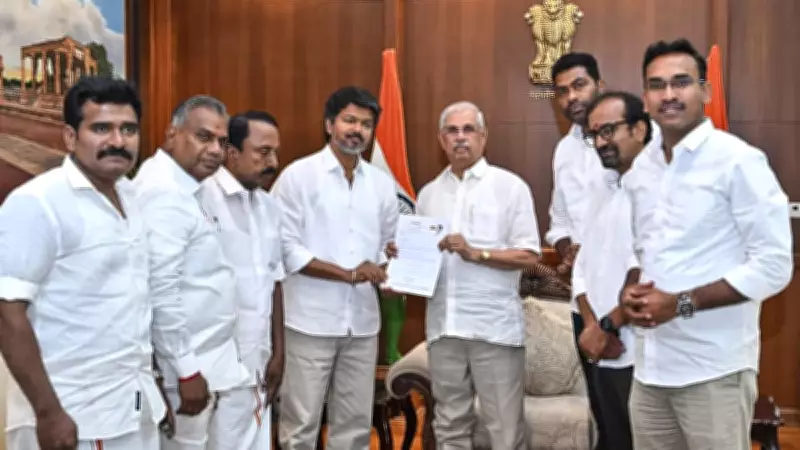
The ongoing impasse in Tamil Nadu over government formation has reignited a long-standing debate about the role of Governors in situations where elections result in a fractured mandate. Questions have arisen over whether the Governor should invite the single-largest party or a post-poll coalition to form the government. This is not the first time such a situation has occurred in India. Several past instances, from Karnataka to Maharashtra and Manipur, have seen Governors' decisions come under intense scrutiny.
Karnataka (2018)
In the 2018 Karnataka assembly elections, no party secured a clear majority. The Bharatiya Janata Party emerged as the single-largest party with 104 seats, but fell short of the 112-seat majority mark. The Congress and Janata Dal (Secular) formed a post-poll alliance, staking claim to form the government. Governor Vajubhai Vala invited the BJP to form the government, leading to a short-lived BJP government under B.S. Yeddyurappa. The Supreme Court later ordered a floor test, which Yeddyurappa lost, paving the way for the Congress-JD(S) coalition to take over. The Governor's decision was criticized for favoring the single-largest party over a pre-poll alliance.
Maharashtra (2019)
In the 2019 Maharashtra assembly elections, the BJP-Shiv Sena alliance won a majority, but disagreements over power-sharing led to a breakdown. The BJP, as the single-largest party, staked claim to form the government, but the Governor initially invited the Shiv Sena, which had allied with the Nationalist Congress Party and Congress. After a brief political drama, the BJP returned to power with the support of the NCP faction led by Ajit Pawar. The Governor's decision to invite the Shiv Sena was seen as a departure from the norm of inviting the single-largest party.

Manipur (2017)
In the 2017 Manipur assembly elections, the Congress emerged as the single-largest party with 28 seats, but the BJP, with 21 seats, formed a coalition with regional parties and independents. Governor Najma Heptulla invited the BJP to form the government, citing the Congress's inability to prove a majority. The decision was challenged in court, but the Supreme Court upheld the Governor's discretion. The case highlighted the Governor's power to assess the ground situation and invite a coalition if the single-largest party cannot demonstrate majority support.
Goa (2017)
In the 2017 Goa assembly elections, the Congress won 17 seats, making it the single-largest party, while the BJP won 13 seats. The Governor invited the BJP to form the government, which allied with regional parties to reach a majority. The Congress contested the decision, but the Supreme Court declined to intervene. The Governor's move was seen as prioritizing stability over the single-largest party claim.
Puducherry (2021)
In the 2021 Puducherry assembly elections, the All India N.R. Congress-led alliance won a majority, but the Governor's decision to invite the BJP to form the government after a political crisis sparked controversy. The case underscored the Governor's role in ensuring a stable government.
Broader Debate
These cases illustrate the ongoing tension between constitutional provisions and political realities. The Governor's decision is often guided by the need to ensure a stable government, but critics argue that the single-largest party should be given the first chance. The Supreme Court has, in several judgments, emphasized that the Governor must act impartially and in accordance with the Constitution, but has also recognized the Governor's discretion in assessing the situation. As Tamil Nadu faces a similar impasse, the outcome will likely set a precedent for future hung assemblies.