

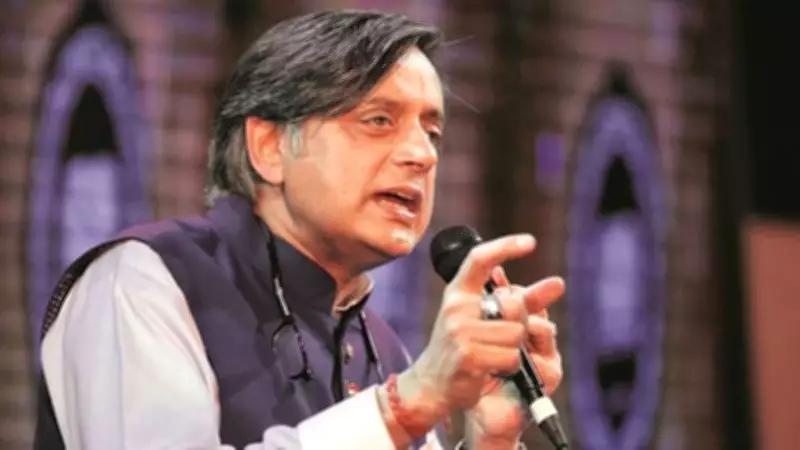
Tharoor Quotes Ghalib, Brands Budget a 'Carefully Created Illusion' in Lok Sabha Speech
Senior Congress leader Shashi Tharoor launched a scathing critique of the 2026-27 Union Budget in the Lok Sabha on Tuesday, terming it a "squandered opportunity" and a "carefully created illusion" that fails to address the pressing economic challenges facing ordinary Indians. Initiating the discussion after days of parliamentary logjam, Tharoor accused the BJP-led NDA government of prioritizing "glossy schemes and utopian projections" over substantive policy action.
Budget Ignores Unemployment, Inequality, and Rising Living Costs
Tharoor argued that the budget's emphasis on capital expenditure appears "less like a strategy for inclusive growth, and more like a gamble" because it overlooks the "lived economic distress of the ordinary citizen." He highlighted that the document ignores unemployment, rising living costs, and inequality, offering little to alleviate the struggles of the aam aadmi (common man). "The government speaks endlessly of welfare, but spending tells a very different story. Behind flashing, flashy announcements lies chronic underutilisation and administrative failure," he alleged.
Shift in Tax Burden from Corporations to Individuals
Terming it "troubling," Tharoor flagged a significant shift in the tax burden, with individuals now bearing a greater share than corporations. He noted that in 2017, corporate taxes were 3.2% of GDP, while income tax was 2.3%. In the current fiscal year, projections show corporate taxes at 3.1% and personal income tax at 3.7% of GDP. "This means revenue is coming disproportionately from individual taxpayers," he said, criticizing the lack of a credible medium-term framework linking spending to employment and productivity.

Agriculture Under 'Existential Threat', Budget Offers Little Relief
Tharoor underscored that agriculture faces an "existential threat" in India, yet the budget does little to consolidate the sector. He pointed out that while agriculture supports 46.1% of the workforce and 60% of the population, contributing 16-17% to GDP, it receives only 3% of the Union Budget. "This under-investment is alarming given the threats from climate change and misaligned farming practices," he stated. He also criticized the Pradhan Mantri Fasal Bima Yojana for "flawed assessments and opaque settlements," reducing compensation to token amounts and failing farmers.
Additionally, Tharoor highlighted that the budget remains silent on revising the PM Kisan Nidhi disbursement, which has stagnated at Rs 6,000 for six years. "You were not able to fulfil your promise of doubling farmers' income; at least increase their honorarium," he urged the government. He also noted the neglect of pepper cultivation in Kerala, where output has declined significantly.
Urban Unemployment Crisis and Neglect of Gig Workers
Tharoor emphasized that urban unemployment has risen to 6.7% as of December last year, while rural unemployment stagnates at 3.9%. He described an employment-related "crisis" concentrated in cities, where "aspirations and frustrations are colliding." Schemes to alleviate this have failed, and the budget is silent on gig workers, who form the backbone of India's new economy. "There is no mention of them in the budget. Their welfare has been deprioritized at a time when unrest grows over the absence of fairly defined benefits," he alleged.
MNREGA Replaced by 'Budget-Restricted' Scheme
Tharoor discussed the replacement of the Mahatma Gandhi National Rural Employment Guarantee Act (MNREGA) with the VB G(RAM) G, highlighting key structural changes that convert it from an open-ended program to a "budget-restricted" scheme. He explained that while it increases guaranteed workdays from 100 to 125 and introduces weekly wage payments, it hollows out the legal employment guarantee by capping central funding and shifting 40% of wage costs to states. "Once a state's allocation is exhausted, workers' statutory right to employment effectively ends," he said, warning that this could lead to technological exclusion and reduced access to work.

Middle Class Bears Brunt of Economic Strain
Terming the middle class the "silent shock absorbers" of the economy, Tharoor argued that the budget fails to alleviate their situation, where borrowing has become "the price of staying afloat." He noted that personal income tax now contributes over half of all direct taxes, while the corporate share declines. "Inflation may look subdued on paper, but for citizens, the cost of living has merely been shifted," he said, pointing out that households are forced to buy private substitutes for public goods like clean water and safe food.
Low R&D Investment and Critique of India-US Trade Deal
Tharoor criticized the budget's capex-centric approach for ignoring weak demand and joblessness, urging the government to elevate research and development (R&D) as a national priority. "India's investment in R&D remains stuck at 0.6% of GDP. A country that aspires to be a manufacturing and knowledge powerhouse cannot afford to treat R&D as an afterthought," he stated.
He also addressed the India-US interim trade agreement, calling it less like a free trade agreement and more like a "pre-committed purchase agreement that overturns every principle of reciprocity." Tharoor alleged that India has "voluntarily surrendered its negotiating power" by committing to buy $500 million worth of American goods over five years, effectively converting a trade surplus into a long-term deficit. "This is not strategic balancing. It is economic preemption," he asserted.
Conclusion: Rhetoric Not Matched by Reality
In his concluding remarks, Tharoor quoted Mirza Ghalib, whose couplets are often cited by BJP leaders, to underscore his critique: "...humein maloom hai Jannat ki haqiqat par dil ko behlane ke liye, Ghalib, yeh khayal accha hai... we know the reality behind these claims, these narratives of modern governance, but they're not policies grounded in outcomes; they're carefully curated illusions." He emphasized that the budget's real weakness lies in its implementation, where "rhetoric is not matched by reality."





