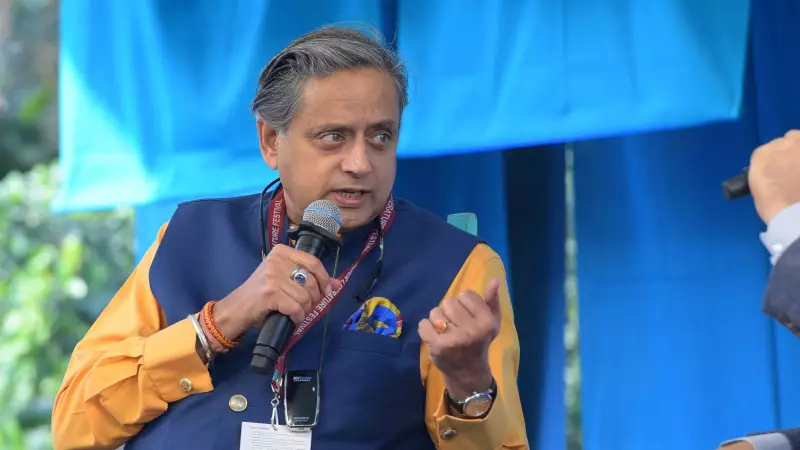
Senior Congress leader and Member of Parliament Shashi Tharoor has launched a scathing critique of the central government's proposed legislation to replace the Mahatma Gandhi National Rural Employment Guarantee Act (MGNREGA). Speaking in the Lok Sabha, the Thiruvananthapuram MP strongly opposed the introduction of the Viksit Bharat – Guarantee for Rozgar and Ajeevika Mission (VB-G RAM G) Bill, labelling it a retrograde step that assaults the foundational spirit of the rural employment guarantee architecture.
An Assault on Philosophical Foundation and Federal Spirit
Tharoor's primary objection centres on the proposed removal of Mahatma Gandhi's name from the scheme. He argued this is not a mere administrative change but an "assault on the very spirit and philosophical foundation" of the programme. He emphasised that Gandhi's vision of 'Ram Rajya' was a socio-economic blueprint rooted in Gram Swaraj (village self-rule), and the original Act, by bearing his name, acknowledged this profound connection to grassroots empowerment.
"To remove the name of Mahatma Gandhi is to strip the bill of its moral compass and historical legitimacy," Tharoor stated, underscoring that the philosophy of placing the last person first was central to the original design.
Financial Restructuring That Threatens Scheme's Viability
The second major point of contention is the proposed financial restructuring. The new VB-G RAM G Bill shifts a significant 40 per cent of the funding burden onto state governments. Tharoor condemned this move, stating it undermines the federal spirit of the original centrally sponsored scheme.
He warned that this sudden and massive shift in liability would render the programme unviable, especially for financially weaker states. "This will inevitably lead to delays in wage payments, a reduction in the number of workdays, and ultimately the destruction of the scheme itself," Tharoor predicted, calling it a clear violation of fiscal federalism.
Executive Overreach and Contingent Implementation
Tharoor's third key objection targets a clause that makes the scheme's operation contingent upon executive notification by the Union government. This provision grants the Centre the power to decide when and where the employment guarantee will be in force.
According to the Congress leader, this fundamentally alters the nature of the programme from a rights-based guarantee to a discretionary one. He argued that this move centralises power and dilutes the statutory guarantee that was the cornerstone of MGNREGA.
In his comprehensive opposition, Tharoor also criticised the bill's proposal to increase guaranteed employment days from 100 to 125 and to pause work during the agriculture season. He concluded that the VB-G RAM G Bill represents a "deeply regrettable and retrograde step" for India's commitment to its most vulnerable citizens, marking a significant departure from a rights-based framework to a more conditional and centrally controlled model.