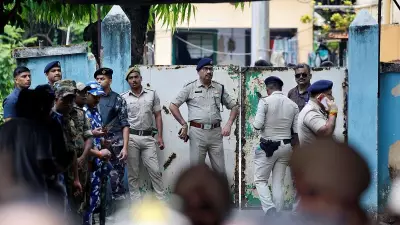
In a significant blow to left-wing extremism in India, a top Maoist leader, who operated under multiple aliases including Uike Ganesh, was killed in a fierce gunbattle with security forces in Odisha's Kandhamal district on Thursday. This encounter brought a dramatic end to an underground life that spanned more than four decades, beginning in the student politics of Telangana and culminating in the inner circles of the banned CPI (Maoist) high command.
From Nalgonda Student to Maoist Commander
The slain leader, originally named Hanumanthu, was born into a middle-class Golla family in Pullemla village, located in the Chandur mandal of Nalgonda district, Telangana. His educational journey saw him complete his schooling at the government high school in Nalgonda and pass his intermediate from the government junior college in the same district. However, his BSc degree remained unfinished.
His life took a violent turn in 1982 during his final year of BSc. Campus politics in Nalgonda had spiraled into bloodshed with the killing of a Radical Students Union (RSU) leader by ABVP activists, followed by a retaliatory murder by the RSU. Fearing arrest as police suspicion fell on him, Hanumanthu chose to disappear, slipping irrevocably into the underground Maoist movement.

The Master of Disguise and the Architect of Jhiram Ghati
For years, Hanumanthu, better known by his alias Uike Ganesh, operated as a key organizer and commander in the West Bastar region of Chhattisgarh. He served as the secretary and in-charge of the West Bastar divisional committee and oversaw the south sub-zonal bureau. Security agencies identified him as a central figure behind several major Maoist operations.
The most consequential of these was the devastating Jhiram Ghati (Darbha Valley) ambush in Sukma district, Chhattisgarh, in May 2013. In this attack, Maoists targeted a convoy of Congress leaders, resulting in the death of 24 people and injuries to 34 others. His alleged pivotal role in planning this operation made him a permanent priority target for police forces across Maoist-affected states, with a bounty of Rs 1.2 crore on his head.
Despite the intense pressure, Hanumanthu remained elusive, earning a reputation as a ghost of the forests. He was a master of disguise, often moving outside forest zones dressed as a swamiji (ascetic), with a stick in hand and a towel slung over his shoulder, blending seamlessly into the rural landscape. Party notes described him as having a black tattoo between his eyebrows and wearing spectacles for long sight. He was known to walk for two to three hours without a break and was fluent in Telugu, Hindi, Gondi, and English.
The Final Showdown in Kandhamal
In his later years, Hanumanthu shifted his base from West Bastar to Odisha, where he continued his activities as the secretary of the CPI (Maoist) Odisha state committee and a member of its central committee. He typically moved with two armed guards carrying .303 rifles, while his own AK-47 and other equipment—including a laptop, phone, printer, batteries, and manpacks—were carried by his gunmen.
This long chapter finally closed in Kandhamal district. Acting on specific intelligence, a joint team of security forces cornered him, leading to the fatal exchange of fire. His death marks the elimination of one of the most wanted figures linked to the bloodiest episodes of the Maoist insurgency in India.
The arc of his life, which began in the heated political atmosphere of a Nalgonda college campus and ended in the remote forests of Odisha, leaves behind a complex legacy. He will be remembered both for his infamous connection to the Jhiram Ghati massacre and for his almost mythical ability to evade capture, often hidden behind the simple robes of a swamiji.