

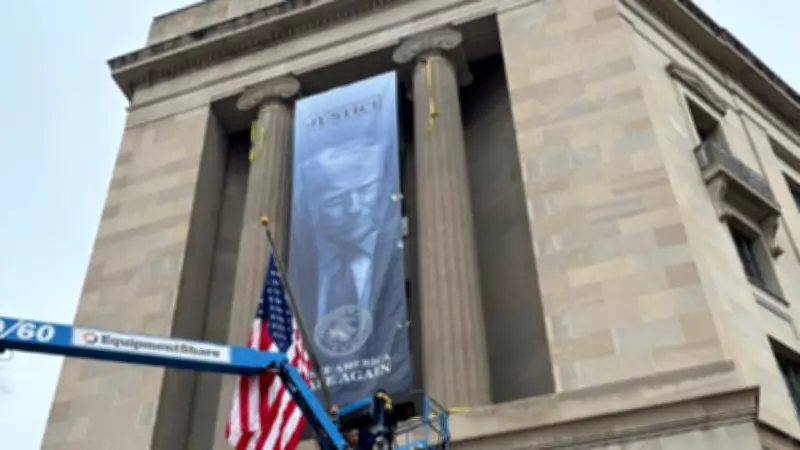
Trump Banner at Justice Department Ignites Political Firestorm in Washington
As the morning commute was still underway in downtown Washington, a massive banner suddenly appeared on the facade of the US Department of Justice headquarters, immediately capturing public attention. The towering display featured President Donald Trump's face alongside the slogan "Make America Safe Again"—a clear echo of his long-standing political branding that now adorns the very agency that once investigated his alleged involvement in the January 6, 2021 Capitol attack.
Symbolic Display at Nation's Top Law Enforcement Agency
Legal experts and political critics were quick to interpret the banner's placement as deeply symbolic, representing what they see as the blurring of lines between presidential campaigning and the independent operation of the Justice Department. While banners featuring Trump have appeared on other federal buildings in recent months, the decision to mount one at the Justice Department—the nation's premier law enforcement body—has generated particularly strong reactions across the political spectrum.
The controversial display comes during a period of heightened federal immigration enforcement operations and ICE deployments across several states, including Minnesota where thousands of federal agents were dispatched earlier this year. These operations, combined with the deaths of two anti-ICE protesters, have already intensified political tensions nationwide.

Department Response and Political Scrutiny
According to reports from The Guardian, administration officials have rejected accusations that the Justice Department has been "weaponized" to advance a pro-Trump agenda, particularly following the dismissal of impeachment-related actions against the president after his 2024 re-election. In a public statement released Thursday, the department expressed pride in "celebrating 250 years of our great country and our historic work to make America safe again at President Trump's direction."
Attorney General Pam Bondi, a longtime Trump ally, continues to face scrutiny from political opponents who argue she has failed to establish sufficient separation between political loyalty and the department's legal responsibilities. Critics contend that the banner's prominent placement represents a concerning politicization of what should be an independent law enforcement institution.
Social Media Erupts with Historical Comparisons
The banner's appearance triggered an immediate and intense reaction across social media platforms, with users drawing dramatic historical parallels:
- "It's reminiscent of Iraq under Saddam Hussein. Next we might see enormous statues of himself along the Potomac, similar to the Colossus of Rhodes, funded by taxpayer dollars."
- "Unfortunately, Washington DC is increasingly resembling North Korea. The November elections are crucial before it becomes irreversible."
- "This situation brings to mind Germany in 1938."
- "The 1984 atmosphere is unmistakable with this president."
Shift in Department Focus Under Trump's Leadership
Since returning to office, President Trump has redirected the Justice Department's attention toward Democratic critics and opponents. This shift has included the dismissal of charges against New York Attorney General Letitia James and former FBI Director James Comey, signaling a significant change in prosecutorial priorities.
The president has also targeted six Democratic lawmakers who publicly encouraged US military personnel to resist what they characterized as "illegal orders" during National Guard deployments in Washington, D.C., and operations involving alleged Venezuelan drug trafficking vessels. Trump has labeled the boat operators as "narco-terrorists" and described the lawmakers' resistance efforts as "seditious." On his Truth Social platform, he provocatively questioned: "LOCK THEM UP???"
The Justice Department banner controversy represents just the latest flashpoint in an increasingly polarized political landscape, raising fundamental questions about the separation between presidential politics and the independent functioning of federal law enforcement agencies.






