

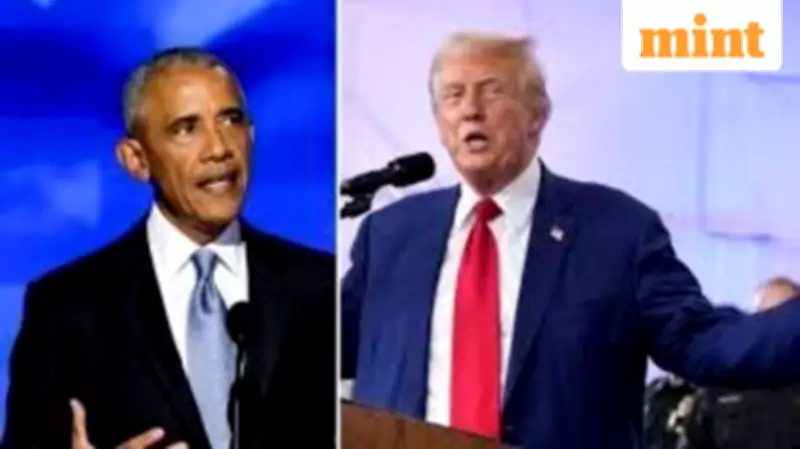
Trump's Social Media Post Features Racist Portrayal of Obamas as Primates
Former President Donald Trump ignited a firestorm of controversy late Thursday night by sharing a video on his Truth Social account that depicted former President Barack Obama and former First Lady Michelle Obama as primates in a jungle setting. The 62-second clip, which was among dozens of posts Trump made overnight, quickly drew sharp criticism for its offensive and racist imagery targeting the nation's first Black president and first lady.
Video Content and Context of the Controversial Post
The video in question appears to be sourced from conservative media content that alleges intentional manipulation of voting machines during the 2020 presidential election in key battleground states. At approximately the 60-second mark, the footage briefly shows two primates with the smiling faces of the Obamas digitally superimposed over them. The imagery was extracted from a longer video previously circulated online by a prominent conservative meme creator.
This content portrays Trump as the "King of the Jungle" while depicting several Democratic leaders as various animals. Notably, President Joe Biden, who is white, is shown as a primate eating a banana in the same video. The song "The Lion Sleeps Tonight" plays in the background during the segment featuring the Obamas.

White House Response and Defense of the Content
White House Press Secretary Karoline Leavitt addressed the criticism surrounding the post, dismissing concerns about its offensive nature. In a text message response, Leavitt referenced Disney's 1994 film "The Lion King," stating, "This is from an internet meme video depicting President Trump as the King of the Jungle and Democrats as characters from the Lion King."
She further added, "Please stop the fake outrage and report on something today that actually matters to the American public." The video was part of a broader series of social media posts in which Trump repeated his false assertions that the 2020 presidential election was rigged against him.
Historical Pattern of Controversial Posts
This incident follows a pattern of Trump sharing controversial content involving racial imagery. Last year, the former president posted an artificial intelligence-generated video showing Barack Obama being arrested in the Oval Office and later depicted behind bars wearing an orange jumpsuit. He subsequently shared another AI-created clip featuring House Minority Leader Hakeem Jeffries, who is Black, wearing a fake mustache and sombrero, which Jeffries condemned as racist.
Since returning to the White House, Trump has faced significant criticism from political opponents for spearheading efforts against diversity, equity, and inclusion (DEI) initiatives across various sectors.
Immediate Political Backlash and Condemnation
The office of California Governor Gavin Newsom, a leading critic of Donald Trump and potential Democratic presidential contender in 2028, issued a strong condemnation of the post. "Disgusting behavior by the President. Every single Republican must denounce this. Now," Newsom's press office wrote in a post on X.
Ben Rhodes, former senior national security adviser and close associate of Barack Obama, also criticized the imagery. "Let it haunt Trump and his racist followers that future Americans will embrace the Obamas as beloved figures while studying him as a stain on our history," he wrote on X.
Broader Context of Election Fraud Claims
The video containing the racist portrayal of the Obamas was embedded within content promoting Trump's persistent false claims about the 2020 presidential election being rigged. These assertions have been repeatedly rejected by courts nationwide and were contradicted by Trump's own attorney general during his first term, who found no evidence of widespread fraud that could have altered the election results.
The controversy highlights ongoing tensions surrounding racial imagery in political discourse and the use of social media platforms to disseminate controversial content during election cycles.






