

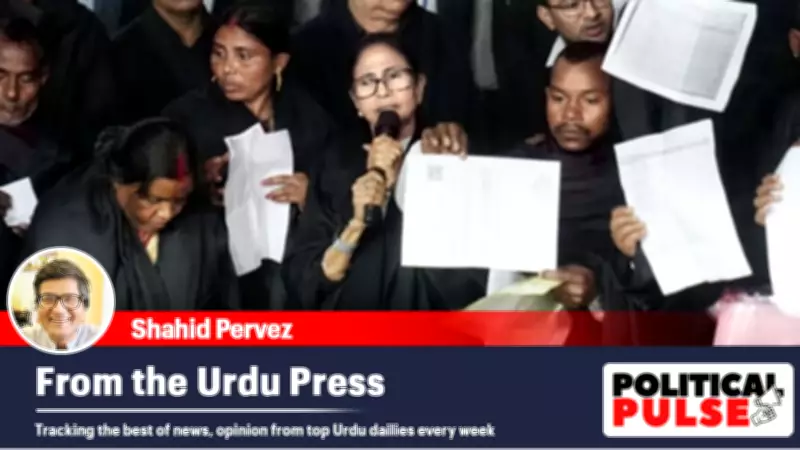
Urdu Press Analyzes Political Turmoil: Parliament Standoff and Mamata's Legal Battle
The ongoing confrontation between the Narendra Modi-led government and the Opposition INDIA bloc has intensified in Parliament, capturing significant attention in Urdu-language newspapers. This conflict reached a new peak as the Opposition submitted a notice for a no-confidence motion against Lok Sabha Speaker Om Birla, a rare move that underscores the deepening rift between the two sides.
Parliamentary Gridlock and Opposition's Rare Move
The standoff was triggered when Leader of Opposition Rahul Gandhi was prevented from quoting from an unpublished memoir of former Army chief General M M Naravane during a parliamentary session. This incident led to days of gridlock, resulting in the suspension of eight Opposition MPs who protested the Speaker's decision.
In its editorial dated February 10, the Hyderabad-based Siasat highlighted that the Opposition has accused the Speaker of adopting a partisan stance, suppressing their voices, and obstructing Rahul Gandhi's speech. The editorial noted that while the no-confidence motion is unlikely to succeed due to the NDA's numerical advantage, it serves as a symbolic gesture by the Opposition to assert their democratic rights.

The editorial emphasized the critical role of the Opposition in a parliamentary democracy, stating that it acts as a watchdog by highlighting government shortcomings and proposing improvements. It argued that while the government may disagree with Opposition views, it must uphold their right to dissent, a principle integral to India's parliamentary traditions. However, the current administration appears unwilling to provide this space, exacerbating tensions in Parliament.
The daily called for both Treasury and Opposition benches to bridge their divide and ensure Parliament functions with dignity, urging them to avoid turning the House into a political battleground despite sharp ideological differences.
Mamata Banerjee's Unprecedented Supreme Court Appearance
Another focal point in the Urdu press is West Bengal Chief Minister Mamata Banerjee's decision to personally argue her case in the Supreme Court against the Election Commission's Special Intensive Revision (SIR) of electoral rolls. This move makes her potentially the first sitting chief minister to do so, drawing comparisons to former Prime Minister Indira Gandhi for her fearless leadership.
The Mumbai-based Urdu Times, in its February 5 editorial, praised Mamata as an "iron lady" who is fighting alleged authoritarianism and subversion of democracy on multiple fronts—from street protests to parliamentary debates and now the apex court. The editorial detailed her efforts, including writing letters to the Chief Election Commissioner, leading delegations of affected individuals, and confronting authorities over the SIR exercise, which she claims targets West Bengal by deleting lakhs of voter names.
Her Supreme Court petition alleges that the Election Commission is "bulldozing" the people of Bengal, and the court has issued a notice to the EC in response. The editorial asserted that Mamata has consistently stayed ahead of the BJP's strategies in the lead-up to the Bengal elections, showcasing exemplary courage and leadership. It suggested that if other secular parties rally behind her, they could collectively challenge the BJP, though the Trinamool Congress is currently contesting independently due to lack of support from other Opposition groups.
Himanta Biswa Sarma's Controversial Actions and Civil Society Response
In a separate development, Siasat addressed a viral video from the Assam BJP showing Chief Minister Himanta Biswa Sarma training a rifle at two men wearing skull caps, with a caption implying violence. The editorial, dated February 9, condemned this as part of a broader pattern of communal politics targeting the Muslim community for electoral gain.
The daily criticized Himanta for undermining his constitutional duties by spreading hate speech, noting his previous derogatory remarks against Bengali-origin Muslims and calls for their mistreatment. Despite widespread outrage leading to the video's deletion, no action has been taken by central agencies or the government.

The editorial pointed out that Himanta faced corruption charges as a Congress minister, but after switching to the BJP, these cases were overlooked, and he was elevated to the chief minister's post. It argued that his escalating communal rhetoric may be an attempt to repay this favor. Given the unlikelihood of impartial action from the BJP-led dispensation, the editorial urged civil society to seek justice through the courts, which remain the only hope for accountability in such matters.
Overall, the Urdu press provides a nuanced analysis of India's current political landscape, highlighting democratic principles, legal battles, and communal tensions that shape public discourse.





