Vadodara Electoral Roll Revision Sees Sharp oter Decline Across All Constituencies
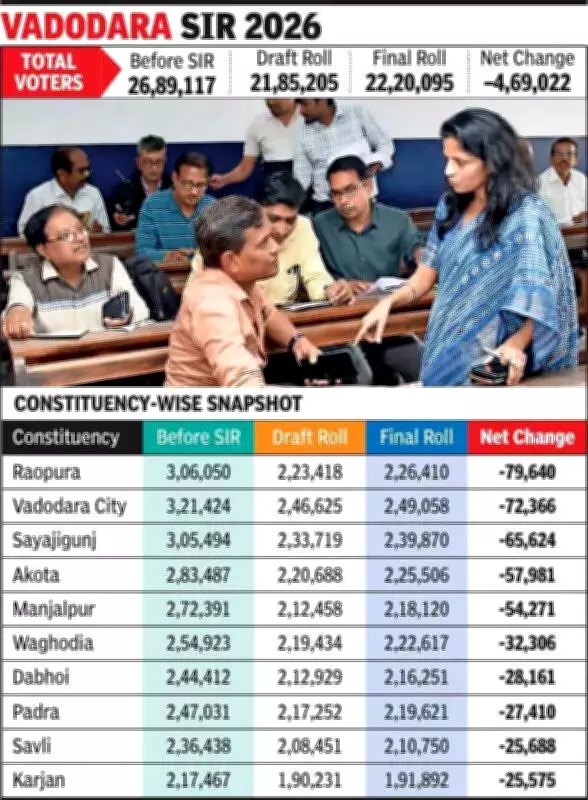
The Special Intensive Revision (SIR) of electoral rolls in Vadodara district has culminated in a substantial reduction in voter numbers, with the final roll published on Tuesday revealing a significant decrease compared to pre-revision figures. The comprehensive exercise, initiated by the Election Commission of India (ECI) last year, aimed to clean and update the voter database, resulting in a final tally of 22,20,095 electors.
Significant Drop in Overall Voter Count
This final figure represents a sharp decline of 4,69,022 voters from the 26,89,117 electors recorded before the SIR drive commenced. The revision process involved meticulous scrutiny and correction of entries across the district's electoral landscape. The first phase of the revision produced a draft electoral roll listing 21,85,205 electors. Following the inclusion and disposal of claims and objections submitted through various forms—Form-6 for new voter registration, Form-7 for deletion, and Form-8 for correction of entries—the final count increased by 34,890 to reach 22,20,095. However, this remains markedly lower than the original pre-revision total, highlighting the scale of corrections made.
Detailed Constituency-Wise Analysis
The SIR exercise led to notable adjustments in all ten assembly constituencies within Vadodara district, with each area experiencing a reduction in voter numbers from their pre-revision baselines. In Raopura, the electorate decreased from 3,06,050 before SIR to 2,23,418 in the draft roll, before a slight increase to 2,26,410 in the final publication. Vadodara City witnessed its voter count fall from 3,21,424 prior to the drive to 2,46,625 in the draft, eventually rising marginally to 2,49,058 in the final list.

Similarly, Sayajigunj's voter base dropped from 3,05,494 before SIR to 2,33,719 in the draft, then increased to 2,39,870 in the final roll. Akota recorded a decline from 2,83,487 voters before SIR to 2,20,688 in the draft, with a subsequent rise to 2,25,506 in the final publication. Manjalpur's figures moved from 2,72,391 voters before the revision to 2,12,458 in the draft, settling at 2,18,120 in the final roll.
Waghodia experienced a reduction from 2,54,923 voters before SIR to 2,19,434 in the draft, before climbing to 2,22,617 in the final list. Dabhoi saw its numbers decrease from 2,44,412 to 2,12,929 in the draft, ultimately reaching 2,16,251 in the final publication. Padra's electorate declined from 2,47,031 before the drive to 2,17,252 in the draft, with a minor increase to 2,19,621 in the final roll.
In Savli, the voter count dropped from 2,36,438 before SIR to 2,08,451 in the draft, then rose to 2,10,750 in the final list. Karjan recorded 2,17,467 voters before the revision, which fell to 1,90,231 in the draft, before a slight uptick to 1,91,892 in the final electoral roll.
Implications of the Revision Exercise
The extensive voter decline underscores the effectiveness of the SIR in identifying and removing duplicate, erroneous, or ineligible entries from the electoral rolls. This rigorous process ensures a more accurate and reliable voter database, which is crucial for maintaining the integrity of the electoral system. The final publication marks a critical step in preparing for future elections, with the revised rolls now reflecting a cleaner and more precise representation of the electorate in Vadodara district.