

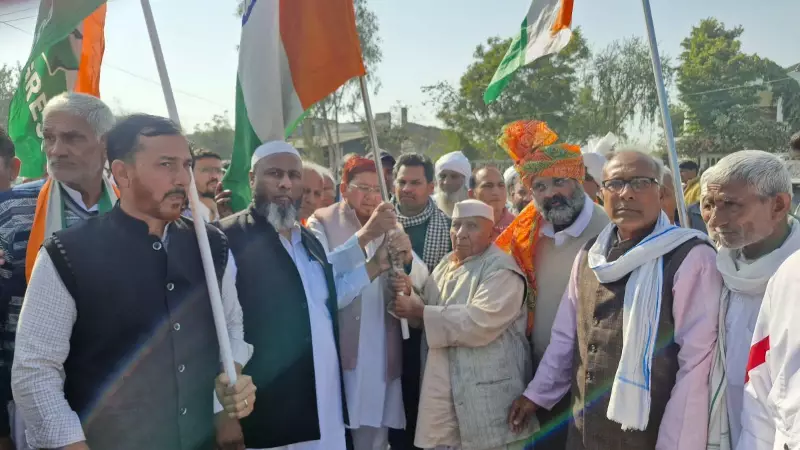
In a significant political development in Haryana, veteran socialist leader and former Lok Sabha MP Pandit Ramkishan has extended his support to the 'Sadbhav Yatra' or Harmony March led by former MP and Congress leader Brijendra Singh. The 99-year-old leader flagged off the yatra in Nuh, located in the Mewat region of Haryana, adding considerable symbolic weight to the ongoing campaign.
A Legacy of Harmony Joins a Modern March
Pandit Ramkishan's endorsement follows similar support from other prominent Congress figures like former Union minister Kumari Selja and leader Randeep Singh Surjewala. Brijendra Singh, who is the vice-chairman of the All India Congress Committee’s Foreign Affairs Department and a former IAS officer, began this extensive journey across Haryana on October 5. In a span of over two months, the yatra has already traversed nearly 1,000 kilometers, engaging with communities on a platform of unity and goodwill.
The choice of Nuh for Ramkishan's symbolic flag-off is deeply historical. Political observers note that Ramkishan is revered in the region as one of the first Hindus to enter Mewat during the turbulent years of 1945-46. At the height of Partition tensions, he courageously worked to persuade Muslims not to migrate to Pakistan. He later documented this experience in his memoir, Main Zinda Hoon: Shatabdi ka Sakshi; Samajwadi ka Prahari.

The Historic Entry into Mewat
Ramkishan's connection with Mewat began when Communist leader and Aligarh Muslim University scholar Dr Kunwar Mohammad Ashraf approached the young activist in Bharatpur, Rajasthan. Ashraf urged him to accompany him to Mewat for peace efforts. While many others hesitated, Ramkishan agreed, marking his courageous entry into the region and beginning a lifelong commitment to communal harmony and social justice.
Throughout his long career, Pandit Ramkishan has been a steadfast champion for the marginalized. He was repeatedly arrested for fighting for the rights of tribals, Dalits, and the poor. At the request of socialist icon Dr Ram Manohar Lohia, he mobilized farmers and farm labourers in Rajasthan’s Bharatpur-Banswara belt during 1958-60. He also played an active role in movements led by Jayaprakash Narayan and Lohia, facing imprisonment multiple times, including during the Emergency period.
Political Stature and Symbolic Impact
Ramkishan's political career includes being elected once to the Lok Sabha in 1977 and four times to the Rajasthan Assembly – in 1962, 1967, 1974, and 1990. His backing of the Sadbhav Yatra is seen as more than just a political gesture; it is an endorsement of the march's core message of social cohesion by a man whose life's work embodies that very principle.
For Brijendra Singh and the Congress, securing the support of a figure like Pandit Ramkishan provides the Sadbhav Yatra with a powerful link to India's socialist legacy and its history of grassroots activism. It elevates the yatra from a contemporary political campaign to a continuation of a historic struggle for harmony and equality, particularly resonant in the sensitive Mewat region. This move is likely to strengthen the campaign's credibility as it seeks to connect with voters across Haryana on issues of unity and shared progress.






