

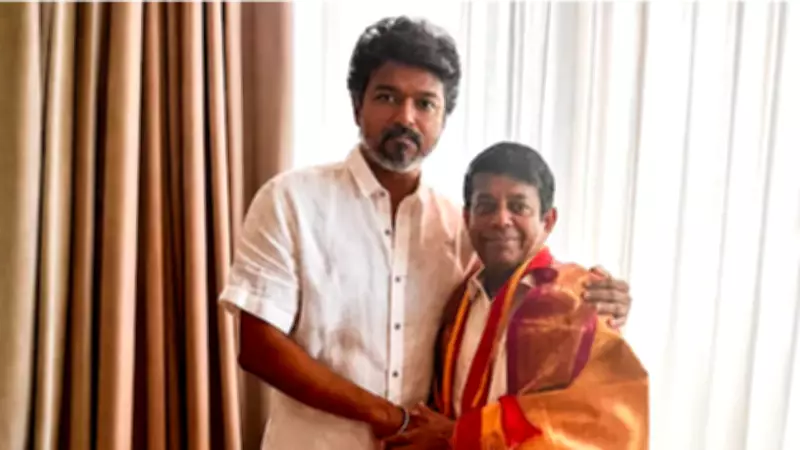
Tamil Nadu Chief Minister C. Joseph Vijay, known for his flawless on-screen heroics, faced a harsh introduction to realpolitik just two days into office. His first political appointment—naming longtime spiritual adviser and astrologer Rickey Radhan Pandit Vettrivel as Officer on Special Duty (OSD) on May 12—sparked such a storm that he was forced to revoke it the next day.
Interestingly, Vettrivel's one-day stint may go down as the shortest for an OSD in the Tamil Nadu Chief Minister's Office. Opposition parties accused Vijay of legitimizing superstition with taxpayer money, while rationalist groups and even sections of his secular support base questioned how such an appointment aligns with Tamil Nadu's deeply Dravidian political culture.
A Rare Political Retreat
The controversy and its abrupt reversal point to unusual political moments. While the appointment raised doubts about the first-time politician's judgment, the retreat reflected a rare courage to bow to public criticism—a trait seldom seen in today's politics.

Astrology in Tamil Nadu Politics
Vijay is not the first Tamil Nadu politician with astrological connections. MGR and his wife Janaki Ramachandran were deeply into astrology, as was Jayalalithaa, who relied on prayers, rituals, and astrological consultations. So why did Vijay face such backlash? Political analyst R. Kannan explains: "This was the first time an astrologer openly claimed to be advising a chief ministerial aspirant and now the CM. Neither MGR nor Jayalalithaa discussed such matters publicly, nor did their astrologers."
Kannan adds that Vijay's astrologer was reportedly also Jayalalithaa's astrologer. During MGR's era, astrologer Vidwan Lakshmanan marked auspicious dates for his swearing-in. In 1984, when MGR fell ill, his wife consulted astrologers through Cho Ramaswamy, who confirmed his recovery and reelection.
Legal Standing of the Appointment
Was Vijay legally wrong to appoint his astrologer as OSD? According to Supreme Court lawyer Gyanant Singh, the answer is no. "Appointment of OSD in the chief minister's office is fully discretionary. Private individuals can be appointed at the pleasure of the chief minister and removed at any point," he says. The OSD typically holds the rank of joint secretary, with tenure at the CM's pleasure.
Why Vijay Backed Down
Unlike many political controversies, Vijay's astrologer row ended with retreat rather than defiance. Having won unprecedented youth support in the recent assembly elections, Vijay could not afford to ignore the messaging debate. "He backed out because he did not want public outrage. Generally, politicians do not go against public view," Singh notes. Vijay's reversal contrasts with West Bengal's Suvendu Adhikari, who faced similar criticism but stuck to his appointments.
The larger question remains: Should taxpayer-funded state offices be used for appointments rooted in personal belief? Vijay appeared to accept that distinction by revoking the order.
The Hidden Influence of Astrologers in Indian Politics
Behind public speeches on development and scientific temper, Indian politics has long maintained a parallel culture of astrology, numerology, and spiritual consultations that cuts across ideology and region. This phenomenon predates modern India. Even the timing of India's independence in 1947 was reportedly influenced by astrological considerations, with the midnight ceremony seen as a compromise.
Former Prime Minister Indira Gandhi was linked to controversial godman Chandraswami, who became a shadow political intermediary. P. V. Narasimha Rao, credited with economic liberalization, was widely believed to consult astrologers. H. D. Deve Gowda aligned political schedules with auspicious timings. Even the inauguration of India's new Parliament building sparked debate over ceremonial rituals and astrological symbolism.

Astrology Across Party Lines
In Bihar, Lalu Prasad Yadav appointed astrologer Shankar Charan Tripathi as RJD national spokesperson in 2017, generating similar controversy. In Karnataka, B. S. Yediyurappa altered his name's spelling based on numerological advice. Maharashtra's Bal Thackeray wore gemstone rings for astrological reasons, and his grandson Aaditya Thackeray changed his name's spelling. Digvijaya Singh openly spoke about astrology. In Telangana, K. Chandrashekar Rao conducted elaborate religious rituals, and his son K. T. Rama Rao faced criticism over branding decisions linked to astrology.
For all its modernity, Indian politics remains profoundly shaped by faith and the belief that power is influenced by the stars. The bond between politicians and astrologers is rarely discussed openly, but it persists across elections, cabinet expansions, and crisis management.





