

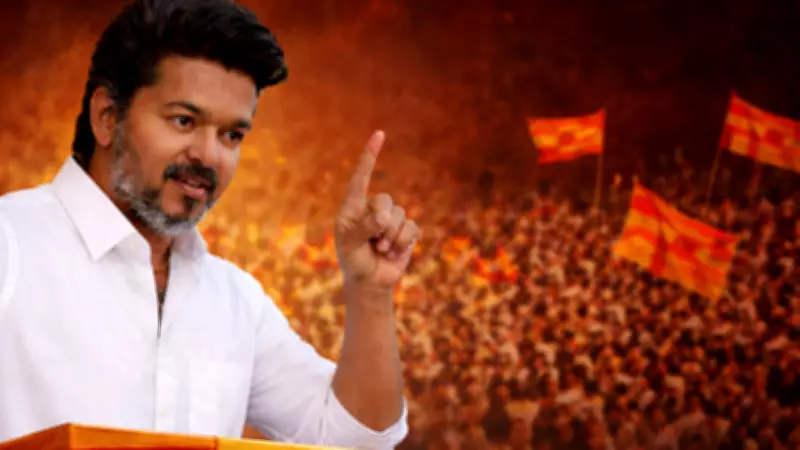
Vijay's Solo Political Gamble in Tamil Nadu: A Structural Challenge to Dravidian Politics
In a dramatic political debut, actor Vijay has placed his first political bet with a bold but risky strategy. By leading the Tamilaga Vettri Kazhagam (TVK) into the 2026 Tamil Nadu Assembly election without any alliance partners, he is stepping into a political arena where coalition-building has historically determined winners for decades. This solo approach represents not just a strategic choice but a fundamental structural challenge to how politics has functioned in the state since the late 1960s.
Historical Context: The Alliance Imperative in Tamil Nadu Politics
Tamil Nadu's electoral system has consistently rewarded coalition depth and organizational spread over standalone appeal. Power has alternated almost exclusively between the Dravida Munnetra Kazhagam (DMK) and the All India Anna Dravida Munnetra Kazhagam (AIADMK), both of which have depended heavily on alliances and entrenched cadre networks to convert vote share into legislative seats.
This pattern is visible across multiple election cycles. In 2021, the DMK-led Secular Progressive Alliance secured a decisive majority, while the AIADMK-led NDA retained over 60 seats despite losing power. Looking further back, the 2011 election saw the AIADMK stitch together a broad coalition that translated into a landslide victory. Similarly, in 2006, the DMK returned to power as part of a pre-poll alliance with Congress and Left parties.

The only partial deviation occurred in 2016 when the AIADMK under J Jayalalithaa retained power with a largely standalone contest. However, this reflected the strength of an already entrenched political force with an established vote base rather than the success of a new, standalone entrant. The historical record clearly demonstrates that Tamil Nadu's elections have rarely rewarded standalone challengers without established voter bases.
The Solo Strategy: Assertion or Electoral Overreach?
TVK has categorically ruled out alliances with both the AIADMK-led NDA and other regional players, framing its campaign as a clean break from entrenched Dravidian politics. Party leaders have been explicit that their objective is not incremental power-sharing but a direct bid for leadership. TVK chief coordinator K A Sengottaiyan emphasized earlier this year that Vijay entered politics with the objective of becoming chief minister, not deputy chief minister.
This positioning gives TVK ideological clarity and preserves its anti-establishment appeal, particularly among urban voters and first-time entrants to the electorate. It also allows Vijay to avoid being subsumed within legacy party structures. However, in electoral terms, a solo contest significantly raises the threshold for success. Without alliance arithmetic, TVK must independently convert visibility into votes across all 234 constituencies, a task that demands booth-level depth beyond mere mass mobilization.
The NTK Precedent: Visibility Without Electoral Conversion
A useful contemporary parallel is the Naam Tamizhar Katchi (NTK), led by Seeman, which has followed a similar trajectory over the past decade. NTK has consistently chosen to contest independently across elections, positioning itself as an ideological alternative rooted in Tamil nationalism. While its vote share increased from around 1 percent in 2016 to approximately 6-7 percent in 2021, the party has failed to win any Assembly seats across these cycles.
Even in constituencies where NTK polled strongly, its votes remained dispersed rather than concentrated, limiting its ability to cross winning thresholds under the first-past-the-post system. For a first-time entrant like TVK, this comparison is instructive. The challenge is not merely to attract voters but to convert dispersed support into concentrated victories—something that has historically proven difficult for solo players in the state.

The Vote-Cutter Dilemma and Organizational Challenges
Rivals, particularly within the NDA, have already framed TVK as a potential spoiler. Leaders including Piyush Goyal have argued that a fragmented opposition could work to the advantage of the ruling DMK by splitting anti-incumbency votes. TVK's core support base—youth, urban middle classes, and politically disengaged voters—overlaps significantly with segments the AIADMK-led alliance is attempting to consolidate.
This creates a structural risk: TVK may erode opposition vote share more than it challenges the DMK's core base. By going solo, the party forgoes network advantages and instead faces the full cost of building an organizational footprint from scratch in a highly competitive field. This increases the risk of vote fragmentation in its core pockets while limiting its ability to convert social appeal into geographically broad, booth-level electoral gains.
From Crowds to Constituencies: The Translation Challenge
TVK's campaign has demonstrated strong crowd-pulling capacity, with large turnouts during Vijay's nomination filings and rallies. His long-standing popularity as a film star adds significant momentum, giving the party visibility that few first-time entrants enjoy. However, Indian electoral history offers repeated caution: crowd density and celebrity appeal do not reliably translate into vote share.
The fundamental challenge is organizational. Established parties like the DMK and AIADMK possess entrenched cadre networks, local influencers, and booth-level machinery built over decades. TVK, by contrast, is still in the process of ground structuring. Without this micro-level apparatus, even a favorable swing in sentiment, however amplified by Vijay's personal appeal, can dissipate by polling day.
Target Constituencies and Dual Contests
By contesting from both Perambur and Tiruchirappalli East, Vijay is signaling an attempt to straddle urban and semi-urban electoral terrains. These are precisely the zones where voter volatility is highest and where TVK's message may find traction. Yet these are also constituencies where multi-cornered contests tend to produce fragmented mandates. The margin for error is narrow: TVK must not only mobilize support but also ensure it is not merely redistributing opposition votes.
Narrative Versus Structural Realities
TVK's campaign narrative focuses on anti-corruption, governance reform, and youth-centric economic promises, calibrated to tap into emerging dissatisfaction. Proposals such as employment-linked incentives, support for creators, and localized job generation aim to differentiate the party from the welfare-heavy Dravidian model that has dominated the state's politics.
The messaging targets younger voters, first-time job seekers, and sections of the urban middle class increasingly vocal about employment opportunities and economic mobility. It attempts to position TVK as a forward-looking alternative prioritizing structural change over incremental welfare expansion. However, elections in Tamil Nadu have historically hinged as much on organizational strength and alliance management as on narrative appeal.
Experience Gap and Political Vulnerability
The party's pitch is also being tested by a parallel line of attack from opponents centered on inexperience. Senior Congress leader P Chidambaram recently drew a sharp distinction between cinema and governance, stating, "Governance is not cinema, there are no retakes," in a pointed reference to Vijay's political debut. He further questioned the party's preparedness and public engagement, highlighting the need for debate and interaction in politics.
Vijay has countered this criticism by emphasizing his commitment to public service rather than political experience. Earlier this year, he responded to criticism over the party's inexperience by stating, "We have no experience in looting," and asserting that his government would rely on administrative support. At a meeting, he called on supporters to take a pledge: "My vote is my right. No one can buy us. Our vote is for whistle."
Strategic Implications for All Parties
For the ruling M K Stalin and DMK, TVK's presence could prove advantageous if it fragments opposition votes in closely contested constituencies, particularly in urban and semi-urban belts where margins are often narrow. Even a modest split in anti-incumbency votes could tilt outcomes in the currently-ruling party's favor.
For the AIADMK under Edappadi K Palaniswami, however, TVK represents a direct strategic threat. The party is attempting to consolidate anti-DMK sentiment, and any diversion of votes, especially among youth and urban voters, could weaken its revival efforts. For TVK itself, the election is existential. A credible vote share, even without significant seat wins, could establish it as a durable political force. A weak conversion rate, however, risks reinforcing the perception that it is merely a spoiler rather than a serious contender.
The Final Test: Rewriting Electoral Rules
Going solo gives TVK full control over its narrative, candidate selection, and long-term positioning. It allows Vijay to present a clear, uncompromised alternative to both DMK and AIADMK and to consolidate an anti-establishment identity that alliances often dilute. However, the risks are structural, not just strategic.
Without alliance partners, every vote TVK attracts must translate into a winning margin on its own. In a first-past-the-post system, even a respectable vote share can result in minimal or no seats if that support is spread thinly across constituencies. The NTK trajectory shows how this pattern can persist across election cycles.
There is also the vote-split effect. If TVK draws disproportionately from anti-DMK voters, particularly in urban and semi-urban constituencies, it could weaken the AIADMK-led bloc more than it challenges the incumbent. In close contests, even a 5–10 percent diversion can tilt outcomes decisively without delivering seats to the third player.
Organizational depth presents another constraint. Unlike DMK and AIADMK, which rely on decades-old cadre networks, caste coalitions, and booth-level mobilization, TVK is still building its ground machinery. That gap becomes critical on polling day when turnout management and last-mile voter outreach often determine results.
Yet the upside scenario cannot be dismissed. If TVK manages to concentrate its support in select constituencies, leverages Vijay's personal appeal effectively, and converts its visibility into targeted vote blocs, it could break the pattern that has historically constrained solo entrants. Even a modest cluster of wins would be enough to establish it as a credible third force.
The 2026 election, therefore, is not just about whether Vijay can win. It is about whether a new entrant can rewrite the rules of a system that has, for decades, rewarded alliances over assertion. In that sense, TVK's solo gamble is less a conventional campaign strategy and more a structural stress test of Tamil Nadu's electoral politics. The real question now is whether this new, rapid appeal can translate into electoral outcomes, or whether the weight of established networks and alliances will once again prove decisive.





