

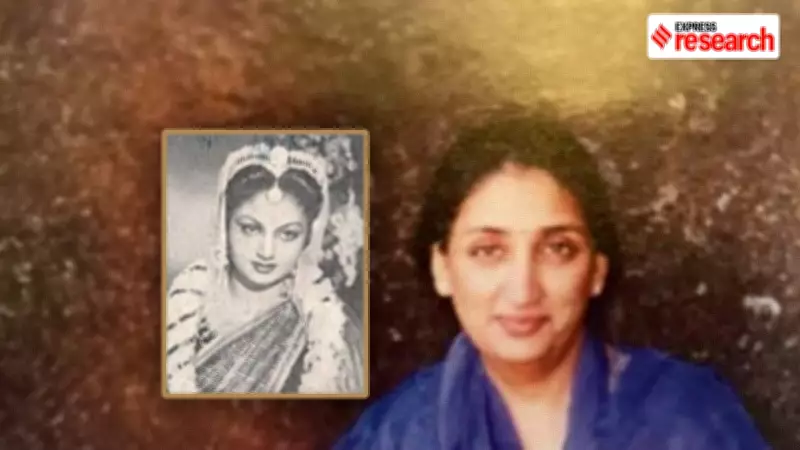
Echoes of Political History: When Widows Stepped Into Their Husbands' Roles
The recent political development in Maharashtra, where Sunetra Pawar was sworn in as the state's first woman Deputy Chief Minister following the tragic death of her husband Ajit Pawar in a plane crash, has drawn attention to similar historical precedents in Indian politics. This phenomenon represents a rare but significant pattern where grieving wives have assumed political positions left vacant by their husbands' untimely deaths.
The Tamil Nadu Precedent: VN Janaki's Brief Tenure
Perhaps the most notable parallel to Sunetra Pawar's situation occurred in Tamil Nadu in 1988, when Vaikom Narayani Janaki, popularly known as Janaki Ramachandran, was sworn in as the chief minister of Tamil Nadu. This came just days after the death of her husband, the legendary actor-politician M G Ramachandran (MGR), who had served as the state's chief minister until his passing on December 24, 1987.
Janaki served as Tamil Nadu's chief minister for exactly 23 days, from January 6 to January 30, 1988. Her appointment followed intense political maneuvering within the AIADMK party, which found itself in a leadership vacuum following MGR's demise after a prolonged illness.

From Silver Screen to Political Arena
Janaki's journey to the chief minister's office was anything but conventional. Originally an actress, she had been married to stage actor Ganapathy Bhat before leaving him for MGR. She subsequently gave up her acting career entirely, choosing instead to focus on being what author Attar Chand described as "the perfect homemaker" in his book M G Ramachandran, My Blood Brother.
This domestic arrangement was dramatically altered when Jayalalithaa entered MGR's life, starring opposite him in the 1985 film Ayirathil Oruvan. For several years, Jayalalithaa lived with Ramachandran while Janaki moved out, though she returned in 1972 after MGR's elder brother intervened. The couple later formalized their relationship with a marriage ceremony at the Mookambika Temple in Karnataka.
The Succession Battle: Janaki vs. Jayalalithaa
When MGR's health began deteriorating in October 1984, requiring his transfer to New York for treatment via a special plane arranged by then Prime Minister Indira Gandhi, questions arose about managing the Tamil Nadu government in his absence. As political commentator Kalyani Shankar notes in The Empress: The Dramatic Life of A Powerful and Enigmatic Leader, a committee was proposed to oversee party functioning that would have included Jayalalithaa, but most senior leaders opposed her inclusion for various reasons.
Following MGR's death, the succession battle within AIADMK crystallized into a contest between two women: MGR's widow Janaki Ramachandran and his political protégé Jayalalithaa. While Jayalalithaa enjoyed MGR's clear designation as his second-in-command and had the support of 33 MLAs, Janaki garnered backing from 99 legislators.
Authors Paranjoy Guha Thakurta and Shankar Raghuraman explain in A Time of Coalitions: Divided We Stand that senior AIADMK leaders saw Janaki as their best chance against Jayalalithaa, believing she could capitalize on the "sympathy wave" expected to follow MGR's death.
A Short-Lived Government and Historical Pattern
Janaki's tenure as chief minister proved brief. The central government dismissed her administration on January 30, 1988, imposing President's Rule in Tamil Nadu. Despite this abbreviated term, her appointment established an important historical precedent in Indian politics.
While no formal legal provision exists for such political succession, history shows multiple instances where widows of politicians have been elected or nominated to political positions following their husbands' deaths. This pattern reflects complex intersections of personal tragedy, political calculation, and public sentiment that continue to shape India's political landscape.
The parallel between Sunetra Pawar's recent appointment and VN Janaki's historical precedent underscores how personal relationships and family connections continue to influence political succession in India, creating unexpected pathways to power during moments of crisis and transition.






